





Cheaper running costs have overtaken environmental concerns as the main reason Australian motorists say they would consider an electric vehicle, according to research by the Australian Automotive Dealer Association (AADA), as Chinese brands tighten their grip on the local market.
The dealer organistion’s national consumer survey found that lower running and recharging costs became the leading motivation for prospective EV buyers in January—overtaking environmental benefits for the first time since it began tracking sentiment more than four years ago.
AADA chief executive James Voortman presented the findings to more than 900 dealers and industry figures at a recent expo.
“This is one of the most significant shifts we have seen since AADA began tracking EV sentiment,” he said. “For years, Australians considered EVs primarily for their environmental benefits. Today, the biggest attraction is their lower running and recharging costs compared with petrol or diesel vehicles.”
Change in Consumers’ Sentiment
Some 45 percent of would-be buyers cited cheaper running and charging as a reason for their interest, making it the biggest driver of future demand, while environmental motivations continued to decline.
Related Stories

Voortman tied the change to instability in global energy markets.
“The conflict in Iran and renewed concerns around global energy markets have focused attention on fuel affordability and fuel security,” he said. “Australians are increasingly viewing EVs through a practical financial lens rather than an environmental one.”
The survey also found 55 percent of respondents agreed rising petrol and diesel prices had made EVs more appealing, with 41 percent of drivers now considering an EV as their next vehicle purchase.
The findings come amid what the association called an unprecedented change in the market. Australia is on track to have 67 EV brands competing this year, with that figure tipped to reach 75 by 2031 as manufacturers chase a share of the growing market.
Buyers took delivery of 103,843 battery-electric vehicles over the past six months, up almost 120 per cent year-on-year.
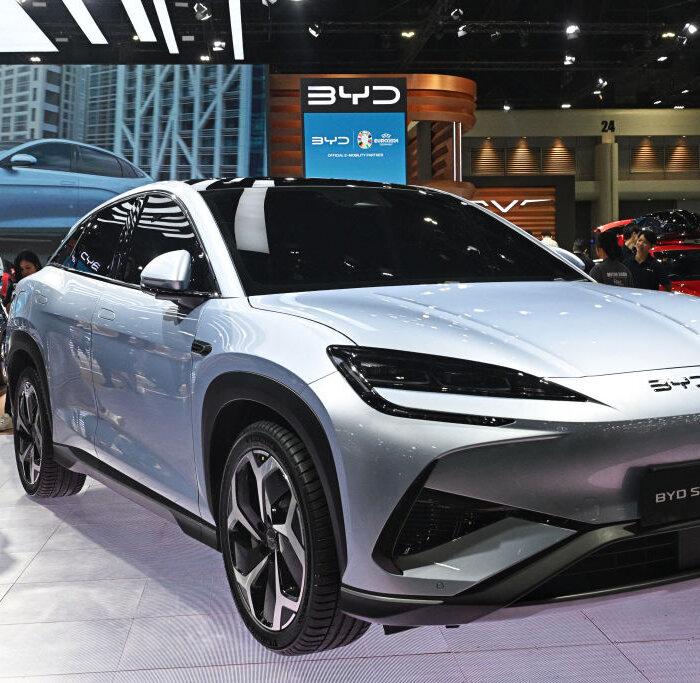
BYD overtook Tesla to become the country’s top-selling EV brand after selling 29,192 vehicles, giving it a 28.1 per cent market share compared with Tesla’s 22.3 per cent.
Voortman said June’s new-car sales results pointed to a transition running ahead of forecasts, particularly among Chinese carmakers.
“Based on recent sales trends, the AADA expects China to account for an even larger share of Australia’s new car market, reaching around 58 percent of all types of vehicles by 2035, exceeding previous estimates,” he said.
Small EVs Cheaper Than Petrol Equivalents
By contrast, rival brands from Korea, the United States and Europe generally start much higher. The best-selling Tesla Model Y opens at about $64,000 drive-away, the Model 3 at around $55,000, and Kia’s EV5 at about $56,770.
Geely’s EX5 small SUV, priced from about $41,990 drive-away, outsold its nearest competitor by more than two to one in the first half of the year, while the Jaecoo J5 electric SUV starts at $36,990 before on-road costs.
Voortman used his speech to urge the Labor government to implement regulatory reform to match the pace of change.
“As this transformation accelerates, the Albanese Government must ensure the regulatory framework keeps pace,” he said. “That means delivering stronger franchising protections for Australian new car dealers and modernising Australian consumer laws to ensure drivers remain protected as new brands enter the market.”