





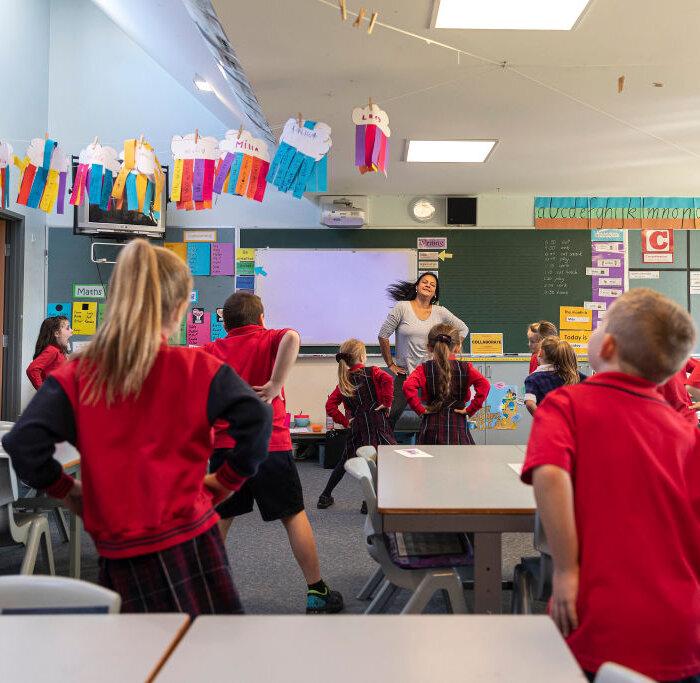
Australian classrooms are facing a persistent disruption crisis, with teachers losing significant instruction time to low-level noise and international testing showing Australia ranking among the most disorderly environments assessed.
Separate findings from the Programme for International Student Assessment (PISA)—a global OECD study—also point to persistent classroom disorder.
Focusing on science classrooms, PISA found Australian classrooms were more disorderly than those in 68 of the 84 other countries and economies assessed.
Related Stories
Unpacking the Root Causes
Against that backdrop, The Epoch Times asked three education and behavioural experts about what may be driving classroom disruption and how schools should respond. A fourth offered a contrasting view on where responsibility lies.
Christa van Aswegen, a registered psychologist and early childhood education expert at Griffith University, said the CIS finding regarding teacher confidence should not be mistaken for resolution.
“Teachers are most definitely not overconfident about student behaviour,” she said.
“While many teachers develop strategies to manage disruptive behaviour and maintain classroom functioning, this should not be mistaken for confidence that the problem has been solved.”
Skills such as listening and collaborating, she added, “are developmental competencies, not innate abilities” requiring explicit teaching, modelling, practice, feedback, and reinforcement.
Professor Robyn Gillies, from the University of Queensland’s School of Education, similarly described self-regulation as a developmental process that continues into adulthood.
“The ability to be able to regulate their behaviours … doesn’t really mature until about their mid-20s,” she explained, noting that teachers need to continuously guide behaviour through routines like forewarning students before activity transitions.
The Cost of Constant Interruptions
Associate Professor Erin Leaf, a behavioural analyst and senior fellow at Monash University’s Higher Education Academy, noted that high teacher confidence figures can be misleading.
“The 82 percent who feel confident may believe they can restore order—not that disruption is rare or cost-free,” she said.
“A skilled teacher can successfully manage dozens of interruptions and still lose a substantial part of the lesson.”
The cumulative effect goes beyond lost minutes, she said, with interruptions fragmenting explanations and leaving misconceptions unchecked.
While Leaf supported implementing a behavioural curriculum, she warned that passive approaches are useless.
“It would not work if it amounted only to a poster, an assembly or a talk at the start of the year,” she said.
Instead, students must rehearse routines during actual lessons, backed by consistent consequences and targeted support.
The Role of the Home Environment
Graham Young, executive director of the Australian Institute for Progress, took a different view, placing greater weight on the home environment.
“There are some things that are hard to teach at school, and there are some things that can only be taught at home,” he said. “But if they’re not taught at home, they make it harder to teach at school.
Young argued that while teachers bear some blame for falling standards, parents bear the responsibility when children enter school from “a home full of chaos and lack of hierarchy.” He added that the issue is compounded when parents “extend the chaos from their homes into the class by unreasonably interfering with how the teachers deal with their children.”
However, van Aswegen, Leaf, and Gillies each cautioned against attributing disruption to parents or any single cause.
Leaf noted that schools “cannot assume that every child arrives having mastered the behaviour needed for classroom learning,” regardless of home life.
Van Aswegen concluded that the “most effective response is unlikely to be either a purely disciplinary approach … or a purely therapeutic approach.”