





Looking after your digestive system involves more than what you eat. Regular movement may also support bowel function while helping relieve stress—an important influence on communication between the gut and brain.
The following routine combines gentle twists, side bends, lunges, and core engagement. This specific sequence offers an accessible way to loosen the body, encourage daily movement, and practice slow, relaxed breathing.
10-Minute Twist-and-Stretch Routine
Perform each movement for approximately 45 seconds, allowing 15 seconds to change positions. For two-sided movements, divide the time evenly between sides.
Move slowly and breathe continuously. Stretch only as far as feels comfortable, without forcing your joints or holding your breath. The routine can be performed at any convenient time, although deep twists, bending, and lying flat may be uncomfortable immediately after a large meal—particularly for people with acid reflux.
Related Stories

1. Seated Torso Twist
Step 1: Sit with your knees stacked in front of you, with both hands placed beside your body.
Step 2: Twist your torso back to the right and hold for a few seconds, then return to center.
Step 3: Twist your torso back to the left and hold for a few seconds, then return to center.
2. Open Book Twist
Step 1: Lie on your back with both arms extended out to the sides at a 180-degree angle.
Step 2: Twist your body to the right while bending your left knee and lowering it toward the floor on your right side. Turn your head to the left and extend your left arm to the left. Hold for a few seconds, then return to center.
Step 3: Twist your body to the left while bending your right knee and lowering it toward the floor on your left side. Turn your head to the right and extend your right arm to the right. Hold for a few seconds, then return to center.
3. Seated Knee-Hold Twist
Step 1: Sit with your knees stacked in front of you. Place your right knee on top and hold it with your left hand. Lower your torso toward the floor while extending your right arm up and back. Turn your head to look toward the right.
Step 2: Return to a seated position and switch sides, placing your left knee on top. Hold it with your right hand, lower your torso toward the floor, extend your left arm up and back, and turn your head to look toward the left.
4. Split Side Stretch
Step 1: Sit with your legs extended out to the sides as wide as comfortably possible. Extend both arms out to the sides at a 180-degree angle.
Step 2: Reach your right arm over your head and bend toward the left, reaching toward your left foot. Hold for a few seconds, then return to center.
Step 3: Reach your left arm over your head and bend toward the right, reaching toward your right foot. Hold for a few seconds, then return to center.
5. Thread the Needle
Step 1: Start on all fours. Thread your right arm underneath your left arm, rotating your upper body toward the left until your right shoulder is close to the floor.
Step 2: Return to the all-fours position. Thread your left arm underneath your right arm, rotating your upper body toward the right until your left shoulder is close to the floor.
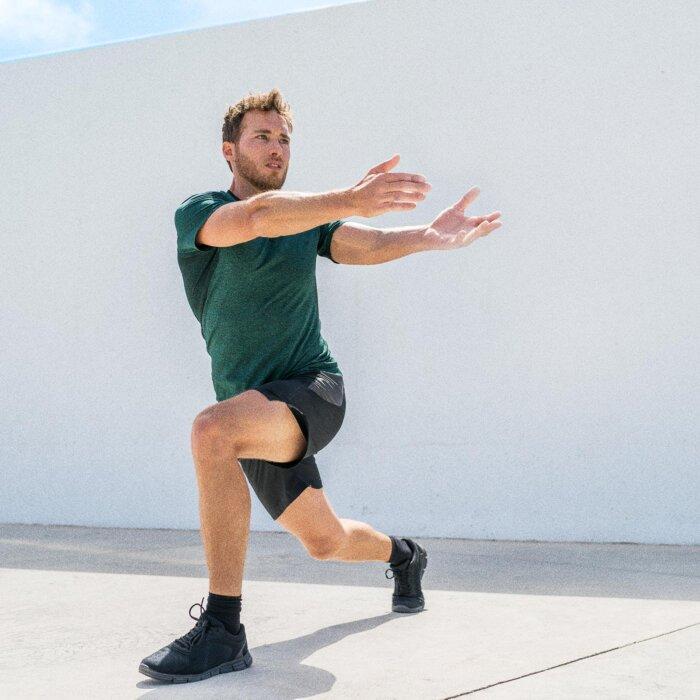
6. Alternating Low Lunge
Step 1: Step your right foot forward into a low lunge. Rotate your body to the left, transitioning into a side lunge with your right knee bent and your left leg extended.
Step 2: Shift your weight from the right side to the left, bend your left knee, and extend your right leg to transition into a left side lunge.
Step 3: Continue rotating your body to the left and transition into a low lunge with your left foot forward. Then repeat the sequence in the opposite direction.
7. Alternating High Lunge
Step 1: Step your right foot forward into a high lunge and extend both arms straight overhead.
Step 2: Lower your arms and rotate your body to the left. Rotate your feet along with your body to transition into a high lunge with your left foot forward, then extend both arms overhead.
8. Russian Twist
Step 1: Sit with bent knees. Your feet may remain on the floor or be lifted off the floor. Keep your back straight.
Step 2: Keep your upper body straight and lean back slightly. Hold your hands together in front of you and rotate your upper body alternately from side to side.
9. Frog With Twist
Step 1: Start in a kneeling position. Move both knees outward to the widest position you can comfortably achieve, with your hands supporting you on the floor.
Step 2: Rotate your body to the right while lifting your right hand and reaching it toward the back right.
Step 3: Rotate your body to the left while lifting your left hand and reaching it toward the back left.
10. Supine Figure-4 Twist
Step 1: Lie on your back with your left knee bent. Hold your left ankle with your right hand, then place your right ankle over your left knee.
Step 2: Lower your right knee toward your left, bringing it as close to the floor as possible, while turning your head to the left.
Step 3: Return to the supine position and switch sides. Bend your right knee and hold your right ankle with your left hand.
Step 4: Place your left ankle over your right knee. Lower your left knee toward the right, trying to bring it as close to the floor as possible, while turning your head to the right.
Make Movement Part of the Bigger Picture
Gentle twists and stretches can help reduce stiffness, engage the trunk, and calm the nervous system. However, they work best as part of a generally active lifestyle. Walking and other forms of regular moderate exercise have stronger evidence for supporting intestinal motility and bowel regularity.
Consistency matters more than depth or intensity. Even if you cannot complete the entire sequence, a few minutes of comfortable movement and steady breathing can be a useful start.
Stop if a movement causes sharp pain, dizziness, nausea, or worsening digestive symptoms. People who are pregnant or have recently undergone abdominal or spinal surgery—or who have a hernia, active gastrointestinal inflammation, unexplained abdominal pain, or gastrointestinal bleeding—should seek medical guidance before performing deep twists or abdominal exercises.