





Rowing as transportation has been with us for thousands of years. Rowing as a sport was mentioned in a 1430 B.C. funerary text for the Egyptian pharaoh Amenhotep, which noted his renowned skill as an oarsman. In the “Aeneid,” composed by Virgil between 29 and 19 B.C., rowing was mentioned in Book V as part of funerary games. Thirteenth-century Venetian festivals called regattas, meaning “contention for mastery,” or “contest,” included rowing races that still continue today around the world.
The history of using rowing machines for exercise dates back to the 4th century B.C., when Athenian general Chabrias developed land-based rowing machines to train new military recruits in the technique and timing of rowing. The innovation raised his crews’ overall skill level and kept them in shape without having to go out on the water all the time. The fit Athenian navy decisively crushed the Spartan fleet during the Battle of Naxos in 376 B.C., reasserting Athenian naval dominance in the Aegean Sea. You might say that the Athenians gave the Spartans a good paddling.
Beyond beating up Spartans, however, rowing-based systems exploded in popularity as the world moved into the industrial era. W.B. Curtis received a patent for a hydraulic rowing machine in 1872, and rowing machines flourished by the 1900s, including the Narragansett rowing machines installed on the Titanic.
You can go to the gym and use a rowing machine, which is technically a full-body workout—you can also easily do rowing exercise at home, using your own body as the machine. The following at-home, machine-free rowing exercises heavily engage your anterior and posterior muscle chains—the entire muscle sets on the front and back of your body, mostly the upper body—and focus deeply on your core musculature as well.
5 Easy and Effective Rowing Exercises
The following exercises should be achievable for almost anyone and anywhere. I suggest, however, that you speak with your medical provider before performing these exercises to ensure that they are right for you.
1. Seated Resistance Band Row
The seated band row is a great place to start building familiarity with the movements. Because it’s performed seated, it eliminates the need for standing balance and leg exertion. It targets the trapezius, rhomboid, and latissimus dorsi muscles, and also includes a focus on the posterior deltoids, biceps, and erector spinae muscles.
Step 1: Sit with your feet about 2 feet apart and stand on an elastic band so it extends equally to both sides.
Step 2: Reach down and pick up the ends of the band, then sit as upright as possible.
Step 3: Pull straight back with your elbows while pulling straight up with your hands. Move until your shoulders move as far as they comfortably can or your elbows reach 90 degrees of flexion before lowering your hands back down. Be sure not to lean forward or back while moving. Instead, keep your back upright and straight the whole time.
Step 4: Bringing your elbows back and your arms up, then back down, counts as one repetition. Try to perform three sets of 15 repetitions.
Modifications: Modify the sets and repetitions to suit your needs. Use stronger or weaker bands to adjust the difficulty. If you can’t pull all the way up with your arms, just pull up as far as you can.
Why I Like Them: This is a superb starter row for those new to rowing movements. It’s also a great exercise for those who are significantly deconditioned, and focusing on shoulder extension instead of flexion can make it accessible for those who have painful shoulders when pushing.
2. Standing Resistance Band Row
The standing band row accomplishes two things at once: It dynamically works your upper body isotonically—contracting muscles while moving joints—while also working your lower body isometrically—contracting muscles without moving joints—and without the contracting muscles themselves lengthening or shortening. This exercise is great for your back, shoulders, and arm muscles, and it also works your glutes and quadriceps.
Step 1: Stand with your feet about 2 feet apart on an elastic band so the band extends equally to both sides.
Step 2: Bend at your hips and knees, pick up the ends of the band from the floor, then stand back up until your hips and knees are bent to about 45 degrees.
Step 3: Keeping your lower body in place and your back straight, slowly pull the band up while moving your elbows toward your hips. Your elbows should move into 90 degrees of flexion by the end of the movement.
Step 4: Slowly relax your arms back out straight. Pulling your arms up and then relaxing them back out counts as one repetition. Try to perform three sets of 15 repetitions.
Modifications: You can decrease your knee and hip flexion to about 25 degrees to make the exercise easier. You can increase flexion up to approximately 90 degrees to make it harder. You can vary the resistance bands to make it more or less challenging for your arms. You can adjust your sets and repetitions to best tailor the exercise to fit your needs.
Why I Like Them: The powerful lower-body strengthening can help you feel more sure-footed. The shoulder flexion and extension under sustained resistance are great for keeping your shoulders limber, and I also like the fact that it targets your rhomboids, which sometimes get neglected in our daily lives.
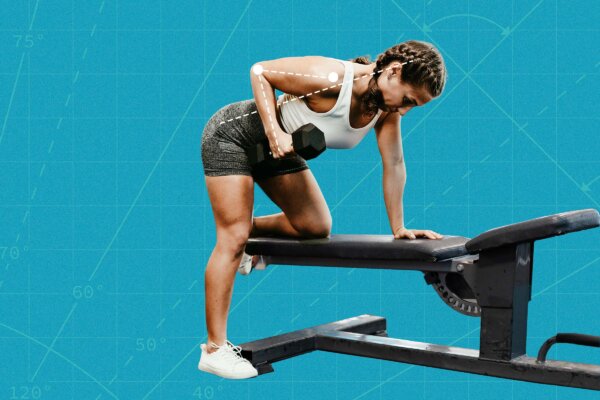
3. Single-Arm Bent-Over Dumbbell Row
This particular exercise is a distinct favorite of mine, and one I perform often in the gym. It’s great for working upper back muscles like the trapezius, posterior deltoid, and rhomboids, as well as the latissimus dorsi and biceps.
Step 1: For this exercise, you can use a bed, couch, or chair. Start by placing your left leg and arm on the surface, with your hip and shoulder at 90 degrees of flexion. Keep your right foot on the floor for stability. Hold a 2- to 5-pound weight in your right hand with your arm hanging straight down.
Step 2: Bend and pull your right elbow straight up. Move into shoulder extension as far as you can, bending your elbow to about 90 degrees of flexion, then lower the weight back down.
Step 3: Moving the weight up, then lowering it back down counts as one repetition. Try to perform three sets of 15 repetitions per side. You can perform alternating left/right sets or perform all sets on one side before performing all of them on the other side.
Modifications: You can perform this exercise with both feet on the floor if it feels more natural or comfortable for you. Just hinge at your hips and use your free hand to support the weight of your trunk as you perform the repetitions. Use variable strength resistance bands to make the exercise easier or harder.
Why I Like Them: I love the upper back emphasis of this exercise, especially how it dials in on your rhomboids. Strong rhomboid muscles resist muscle spasms better than weak ones, and if you’ve ever had a rhomboid spasm, you’ll greatly appreciate that fact.
4. Two-Hand Bend-Over Kettlebell Row
This kettlebell row places both hands on the same resistance source at the same time. It targets the posterior deltoids, rhomboids, biceps, and trapezius. It also focuses on your erector spinae muscles.
Step 1: Stand with your feet approximately 2 feet apart, with a 2-pound kettlebell placed on the floor between them.
Step 2: Keeping your back straight, bend at the hips and knees and pick up the kettlebell with both hands. Straighten your knees to approximately 25 degrees of flexion while keeping your hips at 90 degrees of flexion with your back straight.
Step 3: Slowly pull the weight straight up by pulling your elbows back and up as far as possible, or until your elbows reach 90 degrees of flexion, then slowly lower the weight back down again. Squeeze your scapulae (shoulder blades) together as you perform the movement.
Step 4: Pull the weight straight up, then lower it back down; this counts as one repetition. Try to perform three sets of 15 repetitions.
Modifications: Use a heavier or lighter kettlebell as needed to make the exercise easier or harder. You can increase the angle of your knees to make the exercise harder.
Why I Like Them: My favorite aspect of the Two-Hand Bend-Over Kettlebell Row is its direct action on your scapulae and rhomboids. All rowing exercises involve some degree of rhomboid activation, but this one allows most people to engage their rhomboids effectively.
The Science of Classic Exercises
5. Upright Row
The upright row places the trapezius and deltoid muscles front and center. For the deltoids, it particularly targets the anterior and lateral heads, with a secondary focus on the biceps and brachialis.
Step 1: Stand upright with your feet approximately 2 feet apart, holding a 2-pound weight in each hand. Rotate your hands straight back with your palms facing to the rear.
Step 2: Keeping your posture upright, slowly lift the weights straight up until your shoulders reach 90 degrees of flexion. At the same time, rotate your hands forward until your forearms face straight forward and are horizontal to the ground, with your palms facing downward. Next, lower your hands back down to the starting position. Avoid swaying while performing this activity; tighten your core muscles during the exercise, and try to keep your upper body still.
Step 3: Raising your arms up and then lowering them back down counts as one repetition. Try to perform three sets of 15 repetitions.
Modifications: Use more or less weight as needed. If you can’t lift the weights all the way up, just lift them up as far as possible. Feel free to modify the sets and repetitions to best tailor the exercise to suit your needs.
Why I Like Them: The increased trapezius and deltoid emphasis of this exercise appeals to me because of the stabilizing features involved: Trapezius muscles help stabilize the scapulae, and the deltoid muscles help stabilize the glenohumeral (ball-and-socket) joint of the shoulder. Good joint stability in the scapulae and shoulder now can save you a lot of problems later.
Rowing exercises are powerful medicine for your upper body. They are highly controllable and provide a solid upper-body workout. I suggest performing them at least three times per week, and ideally up to five times per week. I hope these work well for you and wish you luck.
About the Fitness Model: Aerowenn Hunter is a health editor for The Epoch Times. She’s an accredited yoga therapist with more than three decades of teaching experience.
There are many variations on rowing that do not involve needing to have a rowing machine