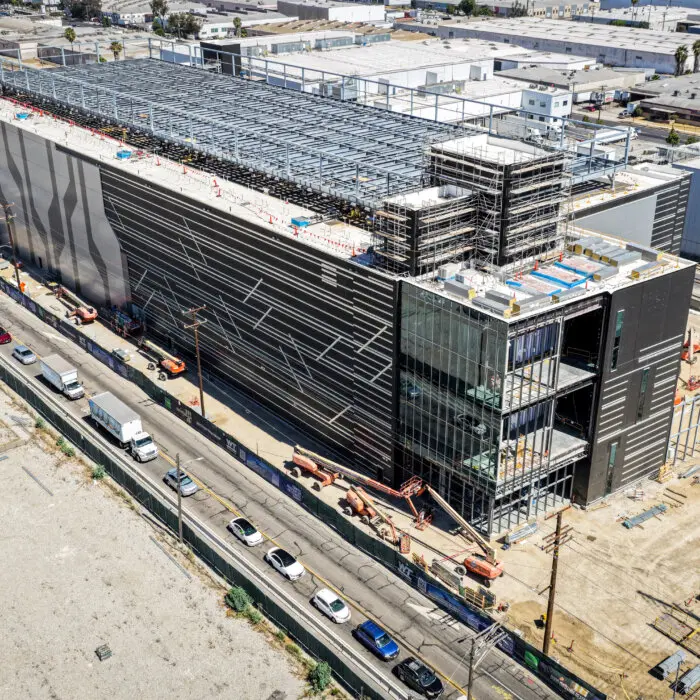
Bell Canada is building what’s expected to be Canada’s largest Canadian-owned data centre outside Regina, seen under construction, on Aug. 27, 2026. The Canadian Press/Jeremy Simes
A majority of Canadians favour limiting the development of large data centres in their provinces, citing water consumption, electricity costs, and the benefits flowing to large tech firms as top concerns, according to a recent Angus Reid poll.
The survey, released Oct. 7, indicated that 64 percent of Canadians want their provincial governments to limit large data centre development, compared to 18 percent who say their governments should encourage building more such infrastructure. Meanwhile, the remaining 18 percent said they are unsure or “can’t say” on the issue.
Among the provinces, Manitoba and the Atlantic Canada provinces responded with the strongest opposition (both jurisdictions at 72 percent), with residents saying their governments should limit building or proposing more data centres to support artificial intelligence (AI), cloud computing and other digital services.
The poll was conducted online from Sept. 8 to 16 among 4,417 randomly selected adults. In British Columbia and Saskatchewan, 70 percent of respondents similarly voiced strong support for limits, while 69 percent in Ontario and 64 percent in Alberta took the same stance.
Quebec showed the least opposition, at 50 percent, which the Angus Reid Institute attributed to the province’s established AI research and technology sectors. However, the institute also cited other research suggesting Quebecers continue to have considerable concerns about privacy, misinformation and employment related to the technology.
Canada’s AI Plans
The poll results come as Ottawa and several provincial governments seek to expand Canada’s AI capacity and computing infrastructure. These include initiatives such as the federal government’s Sovereign AI Compute Strategy, to invest in public and commercial infrastructure, and a proposed large-scale AI data centre project in B.C. in collaboration with Telus, announced in May.
Ottawa has also said it is exploring opportunities that could support up to six gigawatts of new data centre capacity and attract more than $100 billion in potential investment across the country.
Related Stories
At the provincial level, Bell has proposed expanding its AI data centre in Saskatchewan by adding up to 900 megawatts of capacity, thereby contributing to creating a 1.2-gigawatt AI infrastructure hub in the province. The estimated cost of the project could reach as high as $52.5 billion, Ottawa said in a Sept. 14 announcement. The Saskatchewan government said up to 500 jobs could be created once the facility is ready, related to data centre operations and power generation. An additional 3,000 jobs related to security, logistics, and maintenance are projected as well, the province said in its won Sept. 14 news release.
In Alberta, Meta’s $13 billion AI data centre campus in Sturgeon County, near Edmonton, broke ground in July. The project expects to involve about 3,000 construction workers at peak and support more than 300 jobs once operational.
Researchers at Angus Reid said that while governments plan to capitalize on the AI boom, the scale of proposed data centre projects has increasingly raised questions among Canadians about how electricity, water usage, other infrastructure requirements to support the centres would compare with the potential economic benefits.
‘Closely Mirror’
Among the respondents who support limiting data centres, the September poll indicated that 51 percent cited high water usage as their top concern and 38 percent expressed worry that large data centres would lead to higher electricity costs for households and businesses. More than a third (34 percent) said they are concerned that benefits would flow primarily to large technology companies instead of local communities.
Researchers noted the “national principles” announced by Ottawa in early September, which outlined expectations for companies planning to build AI data centres in Canada, “closely mirror” respondents’ concerns.
The framework, announced by Artificial Intelligence Minister Evan Solomon on Sept. 3, includes five expectations for data centres: creating lasting local benefits, not shifting electricity costs to Canadians, minimizing water usage and environmental impacts, being transparent about the impacts to local communities, and bringing strategic value to Canada.
Among respondents who said provincial governments should add more large data centres, 47 percent cited new investment and economic growth as the main reason. Thirty-three percent held the view that constructing data centres could strengthen Canada’s competitiveness in AI and other emerging technologies, while 30 percent said such projects would lead to job creation.
Opposition and Protests
When asked whether they see AI as “a force for good,” more than half of respondents expressed disagreement, with 34 percent saying they “disagree” and 24 percent “strongly disagree.” In comparison, less than 30 percent of Canadians agree with the statement, with 25 percent saying they “agree” and 3 percent “strongly agree.” The remaining 14 percent were either unsure or said they “can’t say.”
Large-scale data centres have been met with opposition in several provinces of late.
In Alberta, hundreds of protestersdemonstrated outside county offices against Meta’s plan for its Sturgeon Data Centre in August, raising concerns about the impact on environment, energy prices, and water and electricity consumption.
Residents in communities including Vancouver, Hamilton, Mississauga, Regina, and Saint John have also raised concerns about electricity use, water consumption, noise, air pollution, and whether the projects will deliver the promised economic benefits.
Paul Rowan Brian contributed to this report.
We had a problem loading this article. Please enable javascript or use a different browser. If the issue persists, please visit our help center.