





Walking offers a multitude of benefits. It reduces the risk of heart disease, diabetes, dementia, depression, cancer—you name it.
However, at least 30 percent of people over 65 have difficulty walking three blocks or climbing one flight of stairs.
As people age, knee pain, limited range of motion, and muscle weakness can make walking more difficult. However, the benefits walking provides are still available. Moving your legs in ways that suit your abilities can still support your overall health.
The following three lower-body exercises are suited to different levels of mobility and leg strength.
3 Exercises to Keep You Moving
Related Stories

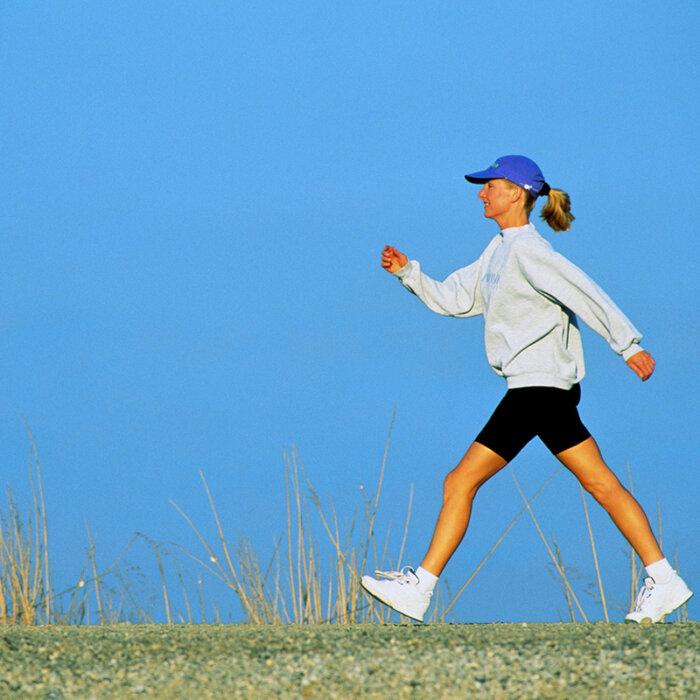
Try the following leg movements based on your current mobility level.
1. Supine Hamstring Stretch
Many people with knee osteoarthritis also experience tightness behind the knee and along the back of the leg. This can make it difficult to fully straighten the knee and create a feeling of stiffness or restriction while walking.
This stretch doesn’t require balancing or bending forward. With your body supported, it gently stretches the area behind the knee, the back of the leg, and the lower back.
The stretch works best when one leg can hang below your body while the other is elevated. A stretching bench, shown below, is ideal. If you don’t have one, place a bed beside a doorway. A securely attached board may also help you get into position more easily and make the stretch easier to do regularly.
Steps:
-
Lie flat on a stretching bench, bed, or other firm, stable surface. Extend both arms over your head.
-
Lift one leg and rest it against a post, wall, or doorframe. Allow the other leg to hang downward naturally but angled slightly inward.
-
Breathe naturally and hold the stretch for about 10 minutes before switching sides. Beginners can start with two to five minutes. Gradually increase the duration of the exercise based on how your body responds.
You should feel a mild pulling sensation along the back of the leg. Don’t stretch to the point of pain. If you feel muscle knots behind the knee, gently pat the area to help release tension before stretching.
According to TCM, a very important energy channel runs through the lower back and down the backs of the legs. Along this energy channel, at the center of the crease at the back of the knee, is an acupoint called Wei Zhong (BL40), commonly used to address discomfort in the lower back, legs, and knees.
2. Single Leg Stand
If you cannot walk for long periods but can still stand safely, this stationary exercise can help train your lower body. It is a great supplement to short walks.
Steps:
-
Stand upright with the back straight and the feet shoulder-width apart.
-
Relax your knees slightly to be sure they are not locked. If your balance is poor, hold on to a table or the back of a sturdy chair.
-
Lift one foot until the toes are 2 inches off the floor and hold the position for one minute. Breathe naturally throughout.
Hold this exercise for one minute on each leg; do one set in the morning and another in the evening. If you are unable to hold the position for one minute, begin with 30 seconds.
3. Seated Heel Raises
Do seated heel raises if you have difficulty standing for extended periods.
These are less physically demanding than standing exercises, but they still effectively engage the calf muscles. They are a good option for people who spend much of the day sitting because they can help maintain metabolic activity in the lower body and reduce some of the effects of prolonged inactivity.
Heel raises primarily target the soleus, a muscle deep in the calf. Unlike many other muscles, the soleus relies heavily on oxidative metabolism, allowing it to continuously use glucose and fats from the bloodstream for energy.
From the TCM perspective, if the lower body can remain active, qi and blood will be less likely to be stagnant, and it will be more conducive to systemic circulation.
You can do these at your desk, while watching television, or during travel.
Steps:
-
Sit on a sturdy chair with both feet flat on the floor, shoulder-width apart.
-
Bend the knees to approximately 90 degrees and relax the body.
-
Keep the toes on the floor while slowly raising the heels as high as possible.
-
Lower them slowly and repeat.
Should You Keep Walking With Knee Pain?
People often wonder whether they should rest an aching knee or continue walking.
1. Keep Moving
Degenerative changes in the knee do not necessarily mean you should stop walking.
Your joints function like a door hinge, and to remain flexible they need regular movement within a range your body can comfortably tolerate.
Staying inactive out of fear of pain can further weaken your leg muscles and further reduce their function, creating a vicious cycle in which pain limits movement and reduced movement leads to greater weakness.
Progress Gradually
Many people assume they must walk at least 10,000 steps every day to see health benefits.
However, even walking roughly 3,800 steps daily was linked to a 25 percent lower dementia risk.
The key to good health is not reaching a fixed step count but staying active within your ability—which may mean you start with only a few minutes at a time. You can spread your activity throughout the day, in the morning, afternoon, and evening rather than doing everything in one session.
Some exercise is always better than none, and gradual progression is the most sustainable.
Stop and Rest When Necessary
Do not force yourself to walk if your knee has become noticeably red, swollen, or warm, or if pain suddenly worsens. Rest and seek medical evaluation to determine whether acute inflammation, an injury, or other joint problems are an issue.
The goal of exercise is not to walk as quickly or as far as possible, but to choose a type of movement that your body can comfortably tolerate and that you can sustain over time.
Note: Anyone who has recently sustained a fracture, is at high risk of falling, or experiences chest tightness, difficulty breathing, dizziness, or pronounced redness, swelling, warmth, or pain in a joint during exercise should stop and seek professional help.