





The Treasury Department has faced scrutiny over whether it can deliver 40,000 social and affordable homes by 2029 under Labor’s $10 billion (US$6.8 billion) housing program.
At a recent parliamentary inquiry on social housing, Ben Rimmer, director-general of the housing group at the Treasury, revealed that 2,199 homes had been delivered to date.
Liberal Senator Andrew Bragg questioned Rimmer on whether the Treasury could deliver 40,000 homes by 2029 at the current rate of progress.
“The auditor general still does say in their report that there is ‘considerable uncertainty’ about meeting the 2029 target,” he said.
Related Stories


“So what do you say about this 2029 target? Just because you have 2,000 today, it doesn’t mean that you’re going to get to 40,000 by the end of the period.”
In response, Rimmer said the HAFF was a “large and complex” construction program.
“Every construction program in the history of human human experience has involved risk and uncertainty,” he told the Senate Economics References Committee.
“This program involves risk and uncertainty in the same way that a motorway in Sydney does, or a stadium in Brisbane does. It also involves quite tight and aggressive timelines.”
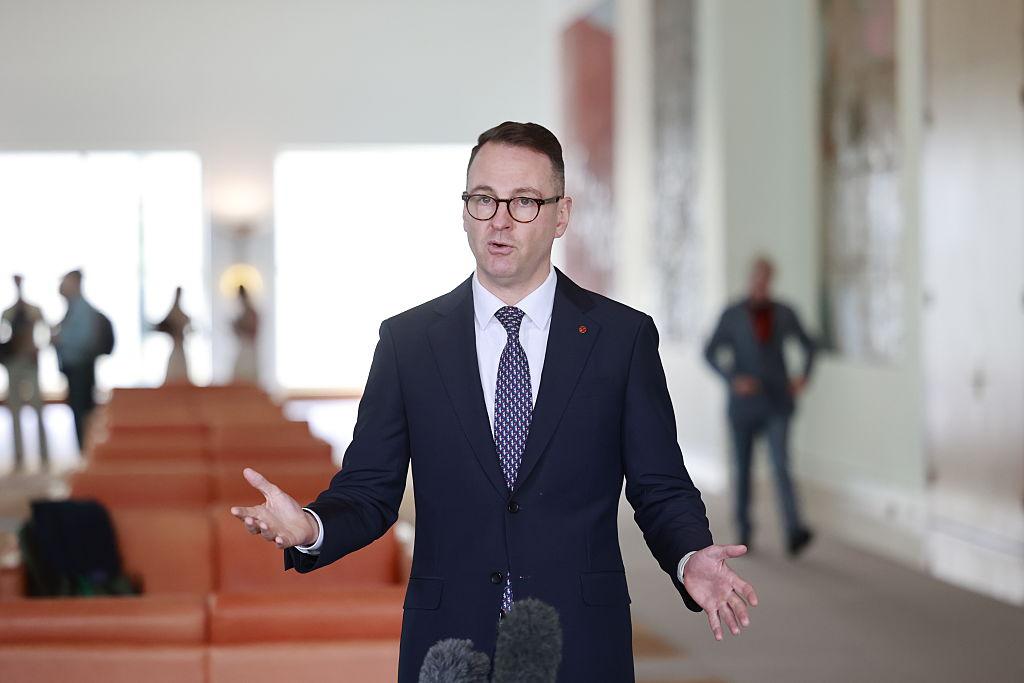
Senator Andrew Bragg speaks to the media at Parliament House in Canberra, Australia, on Nov. 3, 2025. Hilary Wardhaugh/Getty Images
When pressed by Bragg, Rimmer conceded that there were risks that the target could not be met.
“We are fully intent on delivering the government’s commitment of 40,000 by June 2029. But no public servant, no official, no one can give you 100 percent commitment that that target will be hit,” he said.
“We don’t know whether there’s going to be some emerging crisis in construction materials in 2028. No public servant can foresee the future.”
The report also pointed out that there had been insufficient transparency on program delivery, costs, and impact.
Concerns Over Project Costs
Bragg then asked Rimmer about the average cost of each social and affordable home delivered under the HAFF.
The director-general said each home costs $750,000 to develop upfront, of which the federal government contributes about $392,000, with the remainder covered by other parties.
The project is expected to replace 22 ageing homes with 77 new social housing homes with a funding of $48.59 million.
“In that case, it would be 50 million divided by 77 community houses … [or around] $650,000 something per house,” Bragg said.
“When you look at the total capital costs, including the taxpayers’ contribution, it is still a more expensive way of building houses than the average [cost]. I mean the average cost of building a new house in Australia today is about half a million.”
The senator then suggested that the higher costs were due to “other people” getting involved in the project.
“You’ve got the state government, you’ve got the federal government, you’ve got the institutional investors. Everyone’s got to clip the ticket in some form,” he said.
However, Rimmer disputed Bragg’s argument, describing the figures provided by the senator as “misleading.”
“There’s a number of things involved in what you’ve just said. One is the 48 million dollar figure, if that’s what it was, it would probably include land, and I suspect the construction cost number that you’ve just given doesn’t include land,” he said.
“So I think it’s a little bit misleading. I would reject completely the characterisation that everyone involved is clipping the ticket.”