





President Lai Ching-te attends the opening ceremony of the Global Cooperation and Training Framework (GCTF) Workshop on “Building Resilient Democracies: Responding to Transnational Repression,” in Taipei on June 23. 2026. Office of the President of Taiwan
Taiwan is reviewing its legal framework to better counter transnational repression amid growing concern that Beijing uses cross-border intimidation, surveillance, disinformation, and legal pressure to target critics and divide democratic societies.
Speaking at the opening of a 29-country workshop in Taipei on June 23, Taiwanese President Lai Ching-te said authoritarian actors are using emerging technologies, illicit financial flows, cross-border surveillance, cyberattacks, and information manipulation to silence dissent and erode trust in democratic institutions. The president did not directly name China.
Transnational repression generally refers to attempts by governments or their proxies to reach across borders to threaten, silence, coerce, or harm dissenters, along with their families or support networks.
The Chinese Communist Party (CCP) views Taiwan as a part of its territory and has not ruled out the use of force to seize the island or compel it to submit to its rule.
CCP Pressure
The three-day workshop follows months of warnings by some Taiwanese authorities about Chinese pressure that goes beyond military activity.
Related Stories

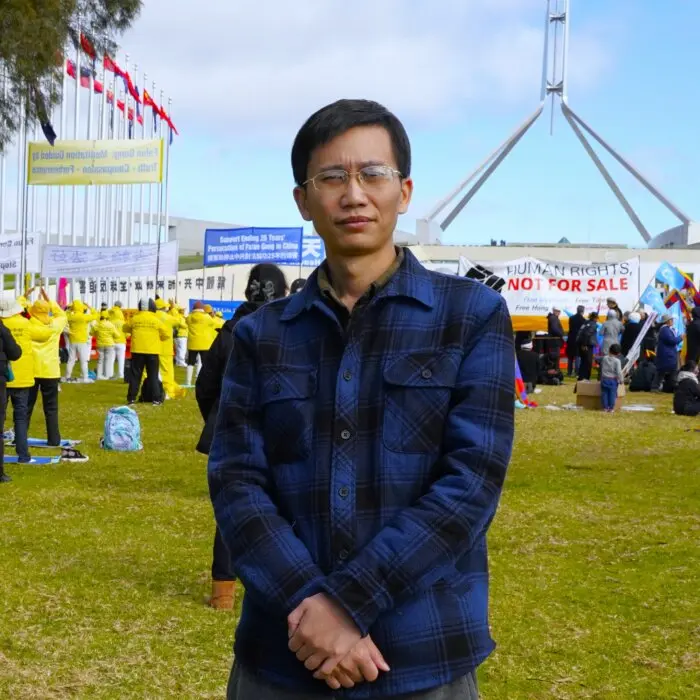
Taiwan has also handled criminal cases involving Chinese intelligence activity.
In August 2025, Taiwan’s High Court sentenced former military officer Hsueh Chen-chun to 14 months in prison over his effort to collect intelligence on the spiritual discipline Falun Gong for Beijing.
Prosecutors said Hsueh solicited details about the founder of Falun Gong, Mr. Li Hongzhi, and his daughter from a Taiwanese investigator under orders from two Chinese intelligence officials, in violation of Taiwan’s national security law.
Falun Gong, also known as Falun Dafa, is a spiritual discipline based on the principles of truthfulness, compassion, and tolerance. First introduced to the public in China in 1992, the practice quickly spread by word of mouth, reaching an estimated 70 million to 100 million practitioners by 1999.
The CCP, fearing that Falun Gong’s popularity threatened the regime’s power, ordered a systematic campaign to eradicate the practice in 1999. Since then, numerous practitioners have faced constant threats of arrest, arbitrary detention, forced labor, torture, and even death by forced organ harvesting.
How Taiwan and Others Respond
Lai said Taiwan has established a system to prevent and effectively respond to transnational repression and to protect its citizens, including government websites that help the public identify disinformation and cognitive warfare.
He said Taiwan has also mobilized its overseas missions to provide emergency assistance and support to Taiwanese citizens who face harassment, intimidation, or repression abroad, while refining its legal system to ensure that perpetrators are held accountable.
Canada, the United States, Japan, Australia, and the United Kingdom co-organized the workshop with Taiwan through the Global Cooperation and Training Framework, a platform established in 2015 by Taiwan and the United States.
Marie-Louise Hannan, executive director of the Canadian Trade Office in Taipei, said at the opening ceremony that Taiwan’s democratic resilience and civic engagement offer lessons for democratic partners, according to Taiwan’s foreign ministry. She called for deeper cooperation to address transnational repression and emerging-technology threats.
The European Union and the United States are building legal and policy responses to transnational repression.
The European Parliament adopted a report on June 16 that called for a “zero-tolerance” response. The report urged improved data collection, specialized law-enforcement training, and the creation of an EU coordinator role to address threats, including digital repression, abusive Interpol notices, and consular coercion.
The U.S. Congress introduced the Transnational Repression Policy Act in 2025 in both the Senate and House. A separate Senate resolution that would condemn the Chinese regime for engaging in transnational repression was reported out of the Senate Foreign Relations Committee in October and placed on the Senate calendar.
The Congressional-Executive Commission on China said in a June 4 report that Chinese authorities and their proxies targeted critics of the CCP, diaspora communities, human-rights advocates, elected officials, researchers, artists, and civil society groups outside China in 2025.
U.S. prosecutors have also brought criminal cases involving CCP-linked repression. John Chen and Lin Feng, both California residents, pleaded guilty in 2024 to acting as unregistered agents of China and bribing a public official in a plot targeting U.S.-based Falun Gong practitioners.
Chen and Lin were later sentenced to 20 and 16 months in prison, respectively.
Lai said Taiwan would continue working with the EU and other like-minded partners to build a trustworthy information environment, faster early-warning systems, stronger accountability mechanisms, and a more complete protection network.