





Not everybody with pelvic floor problems struggles with weak muscles, however. In fact, some people can experience exactly the opposite: their muscles are too tight. This presents, of course, a different kind of problem that requires an entirely different kind of solution.
6 Stretches to Relax Your Pelvic Floor
Thankfully, I have a handy set of exercises close by that we can use to help relax tight pelvic floor muscles and help you reap the benefits of a properly balanced pelvic floor.
These are great, easy-to-perform exercises, but I suggest that you speak with your medical provider to ensure they are right for you.
1. Diaphragmatic Breathing
Breathing high, from your upper chest, not only doesn’t encourage relaxation, but can actually increase stress, especially if you confine your breathing to short, fast intakes and exhalations. When we see this breathing pattern in patients, we’re quick to cue them into proper, deep breathing. Like I tell my patients: stress breathing is bad, deep breathing is good, and diaphragmatic breathing is best.
Step 1: Lie on your back with your arms by your sides. If needed, you can bend one or both knees and place your feet flat on the floor to take pressure off your back.
Step 2: Place one hand on your stomach and one on your chest, and breathe in, making sure the breath raises the hand on the stomach without overly raising the hand on your chest—diaphragmatic breathing originates low in the ribcage. Draw your breath in slowly, taking approximately three seconds, hold for one second, then release for four to six seconds.
Step 3: Perform for one minute per set and try to perform three sets.
Related Stories
Modifications: You can modify sets and times to best suit your needs. It’s not a bad idea to couple this activity with soothing instrumental background music. You can also perform this exercise in a sitting position—just be sure to sit back and relax.
Why I Like It: This is an excellent exercise to begin your relaxation session and can help set the tone for the rest of it.
2. Happy Baby Pose
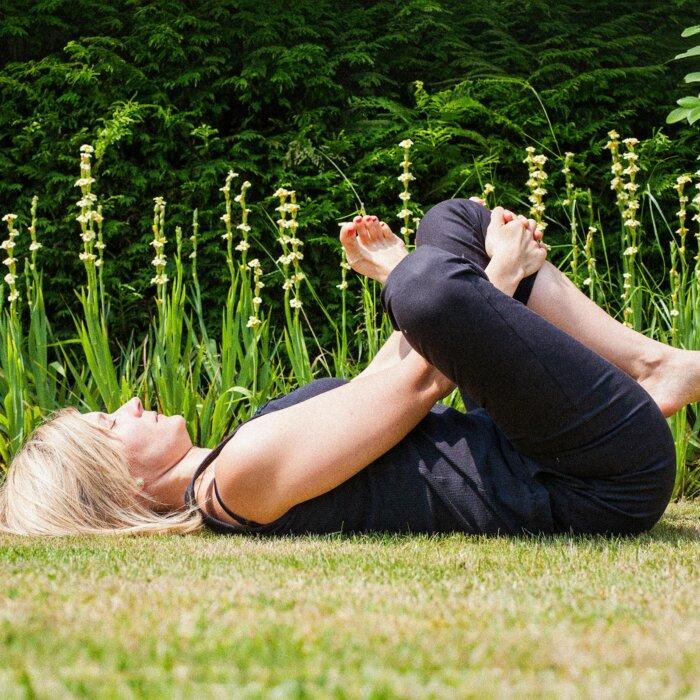
Happy Baby Pose can make you happy, baby. It not only provides a great stretch for your inner thigh muscles, but also offers an excellent, focused relaxation for your pelvic floor.
Step 1: Lie on your back with your knees bent and your feet flat on the floor.
Step 2: Draw your knees up to your chest and take hold of the outside of your feet—or your knees if you can’t get your ankles up high enough.
Step 3: Move your feet away from each other until you feel a gentle (repeat, gentle) stretch along your inner thighs, while gently pressing your knees straight down toward the floor. Hold this position while working to relax your pelvic floor. The best visualization is to try to relax your pelvis as much as you can.
Step 4: Hold for approximately 30 seconds before returning your feet to the ground, then repeat after a short rest. The 30-second hold is to give you enough time to relax your pelvis effectively.
Step 5: Try to perform the pose three times, feeling free to experiment with numbers and times to make the activity work best for you.
Modifications: Only move your legs into as much of a stretch as you can comfortably tolerate. Ideally, hold onto your feet, but if that’s a little too hard for you, just try to hold onto your ankles or even your knees.
Why I Like It: Happy Baby Pose puts you directly in charge of pelvic floor relaxation. The high degree of hip flexion and elevated pelvis all combine to make it really easy for you to directly relax your pelvic floor.
3. Child’s Pose
Child’s Pose is a nice, deep stretch for big muscles like your hamstrings and gluteal muscles, and it releases tension in the lower back. It also provides effective relaxation for your pelvic floor muscles.
Step 1: Start on your hands and knees on a firm, supportive surface.
Step 2: Keeping your hands in place, slowly relax your hips back toward your heels.
Step 3: Once you’re sitting on your heels, slide your arms a little farther forward as you drop your forehead toward the ground. Practice slow, controlled breathing the entire time.
Step 4: Hold this position for approximately 15 seconds before returning to the starting position. Try to perform this stretch four times.
Modifications: If you can’t sink very far into hip flexion, just sink down as far as you can. Also, only stretch your arms as far as you comfortably can. If your forehead doesn’t reach the ground, place a yoga block or a firm pillow under your forehead for support, so you can effectively relax into the position.
Why I like It: In addition to helping relax your pelvic floor, Child’s Pose provides a great stretch for your hamstrings and lower back. Tightness in these areas can contribute to increased and persistent tightness in your pelvic floor, so it’s important to relax them as well.
4. Seated Figure-4 Stretch
The Seated Figure-4 Stretch seems custom-designed to focus on your piriformis muscles, and it does. It’s also a great exercise for relaxing the pelvic floor and getting it into a friendlier disposition, because it provides a gentle, sustained stretch for the whole area.
Step 1: Sitting near the front of a chair, cross your right leg over your left leg and position your right ankle just behind your left knee. Use your arms to help hold your leg in position if you need to. Allow your right knee to slowly relax down as far as it will go while keeping your right ankle in place. Sit still for approximately 15 seconds and let the stretch settle in.
Step 2: Slowly bend forward at your hips and move into the stretch as far as you comfortably can; be sure to keep your back straight. You will feel the stretch rapidly intensify. Hold the stretch for one minute, or as long as you comfortably can, then repeat the movement on the left side. Try three one-minute stretches on each side.
Modifications: If you can’t lower very far into the stretch, just lower your knee as far as you can. Alternatively, you can perform this exercise on your back by crossing your ankle above your knee with one hand and providing gentle pressure on the other knee to increase the stretch force.
Why I Like It: The Figure-4 is big medicine for the piriformis muscles, so stretching it out helps relax your pelvic floor.
5. Butterfly Stretch
“Shelley, you’re too tight.” These were the fateful words of my childhood karate instructor, Jack Motley. That was the day he introduced me to the Butterfly Stretch, something he had me do during every pre-sparring warm-up from then on. At first, I hated it because it really challenged me, but then I began to love it as it worked its magic, and so will you (at least in time).
Step 1: Sit upright on the floor, with the soles of your feet together, then use your arms to draw your feet as close to your pelvis as you can.
Step 2: This alone can provide an amazing stretch for you, but I next encourage you to focus on relaxing your legs, letting your knees sink as the muscles relax.
Step 3: Hold this position for as long as you feel comfortable or for one minute before moving out of the stretch and resting. Be sure to move only as far as you can comfortably, so you can practice relaxation breathing while you stretch.
Modifications: Be sure to sit upright when performing this exercise to maintain tension in your core musculature. Only move your knees down as far as you can comfortably tolerate. Sensei Motley also taught me a trick: If prolonged passive stretches are a little too intense, you can move your knees down to close to your maximum stretch and then lightly “bounce” your knees up and down a couple of inches, with the small contractions and relaxations often helping to limber you up even more.
Why I Like It: This exercise is great for stretching the inner hip, thigh, and groin muscles, and is great for relaxing muscles that have grown tight from sitting, including your pelvic floor. Who knows, you may be able to beat karate opponents if needed, though the butterfly stretches never actually helped much with that one mean girl in my class named Liz, who always delightedly put a whoopin’ on me every time she could.
6. V-Stretch
Two of the most consistently tight things in the universe are leg adductor muscles and my Uncle Reggie, who was said to be so cheap that he invented a way to light the same match three times. OK, I never had an Uncle Reggie, but the hip adductor part is spot on, and the V-Stretch dials in on them harder than a revenuer man on a moonshiner.
Step 1: Find a nice, open wall and lie down in front of it with your hips bent, your sit bones touching the wall, and your legs pointing straight up toward the ceiling, knees straight. Place your arms straight out to the sides and let your body relax in this position for approximately 15 seconds.
Step 2: Next, slowly relax your legs into a “V” formation. While here, focus carefully on relaxing your pelvic floor muscles, which is made easy by the position of your body in this exercise. Only stretch as far as you comfortably can and hold there for as long as you can before you feel the need to come back up. When you’re ready, use your hands and core muscles to draw your legs back to the starting position, then rest there until you’re ready to stretch again.
Step 3: Try to hold each stretch for up to one minute, breathing slowly and relaxing into it, but don’t push it. Just do what you can, especially at first. Moving into the stretch, then back up into the starting position, counts as one set. Try to perform three total sets.
Modifications: Only move your legs as wide as you comfortably can before holding the pose. If you can’t move fully against the wall , just move it up as close as you comfortably can.
Why I Like It: The V-Stretch places a magnificent stretch on your hip adductors and, by relaxing them, decreases tightness along the pelvic floor. You also work directly on your pelvic floor at the same time.
If you have pelvic tightness, we’ve got exercises to help. I suggest that you perform these at least three times per week. Ideally, every day, or as often as you need them. Whether tight or loose, pelvic floor muscles that are out of balance can cause problems for you, and I hope these exercises help you recover better pelvic balance. Good luck, and I hope they work well for you.
About the Fitness Model: Aerowenn Hunter is a health editor for The Epoch Times. She’s an accredited yoga therapist with more than three decades of teaching experience.