





Myopia rates in the United States have nearly doubled since the 1970s, when they were 25 percent, with 50 percent expected by 2050. As those numbers climb, a growing number of optometrists and vision researchers are asking whether the standard fix of a stronger prescription is the only one worth offering. Newer approaches aim to slow vision loss or strengthen vision rather than simply correct it, though eye doctors quickly note that skipping needed correction entirely carries its own risks.
“We now have a lot of options that have been in place for a long time that can really move the needle,” Dr. Bryce Appelbaum, an optometrist with additional training in developmental and behavioral vision care, told The Epoch Times.
Vision Support Alternatives
Four approaches to vision care are getting the most attention: specialized overnight lenses that reshape the cornea, glasses and contacts engineered to slow eye growth, specialized eye drops, and daily vision exercises. Each works differently, and the evidence behind their effectiveness varies.
Orthokeratology Lenses
Like a retainer for the eyes, orthokeratology contact lenses are worn overnight to gently reshape the cornea’s curvature during sleep. They restrict the uncharacteristically fast growth of the eyeball, which can become misshapen into an oval and cause nearsightedness.
Myopia-Control Glasses and Contacts
Stellest lenses use rings of varying focus power to keep the center of vision sharp while softening the periphery, a pattern that signals the eye to slow its growth. They’re the first spectacle lens the Food and Drug Administration has approved specifically for slowing myopia progression in children, and a two-year study found they cut progression by an average of 71 percent with consistent use. MiSight contact lenses work on a similar principle.
Low-Dose Atropine Drops
Functional Vision Therapy
Vision therapy uses daily exercises meant to improve how the eyes and brain coordinate tracking and focus—essentially muscle training for the eyes. Meir Schneider offers an extreme case for what is possible: Born legally blind, with scar tissue covering 99 percent of his lenses after childhood cataract surgeries, he built his sight to about 70 percent of normal through a regimen he began at 16, practicing up to 13 hours a day. He now runs the School for Self-Healing, teaching the exercises worldwide.
Retraining Our Eyes
While conventionally used only for eye disorders—not refractive errors such as nearsightedness and farsightedness—a growing field of behavioral optometrists suggests vision therapy can improve blurry vision from eye fatigue and screen use.
Eye Pushups
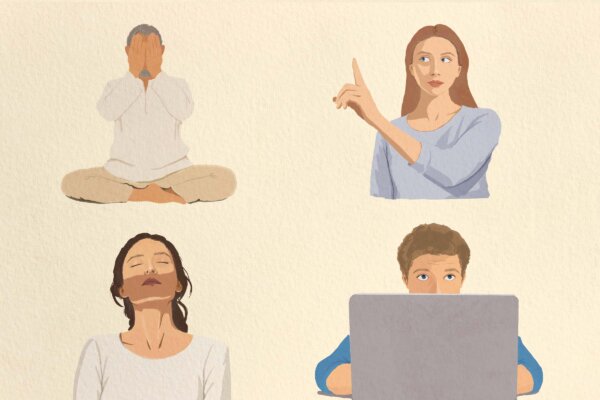
Stand in front of a window or outside with a distant view. Cover one eye. Hold up your finger with your arm extended. With your fingertip facing you, slowly bring it to your face until you can see the details of your fingerprint. Hold the finger there, focusing on it for several seconds. Shift your gaze to the distant view for several seconds. Gently move your gaze back and forth for a couple of minutes on both eyes.
Sunning
Face the sun outside with your eyes closed, moving your head side to side and chin to shoulder. The sunning exercise, done in two three- to five-minute sessions daily, helps with visual contrast and light sensitivity, Schneider said.
“I was able to start seeing things in the sun, and that was the beginning of me starting to see 4 percent,” Schneider said. “Things became clearer and clearer. I would basically see fuzzy shapes, and then I could see the head versus the shoulders” of people.
Palming
Rub your hands together to warm them, breathe deeply while resting your palms gently over your closed eyes, elbows supported, in a dark, quiet room. Schneider uses this several times a day to relax his eyes.
Behavioral optometrists argue the benefits extend past eyesight. “When you’re training the eyes, you are directly improving the function of the brain in significant ways,” Jacob Liberman, a vision researcher and retired optometrist, told The Epoch Times.
When a Quick Fix Becomes Permanent
Sometimes lenses are prescribed for self-resolving problems because patients or the doctor want a quick solution, Liberman said.
“No one questions [the need for glasses]—not the doctors or the patients,” he said. “Most of the time we don’t go for second opinions because everywhere we look, everybody’s wearing glasses. We’ve come to accept it as the rule rather than the exception.”
Liberman compared glasses and contact lenses to crutches: worn constantly, they can prevent the eyes from ever being strengthened or challenged, which may let prescriptions creep stronger and myopia worsen over time. Solutions include wearing glasses with slightly less correction to challenge the eyes and going without glasses when it’s safe to do so, to build eye strength and give the eyes manageable, healthy stress.
Habits That Help Support Vision
Short of formal therapy, doctors point to daily habits that ease eye strain: the 20-20-20 rule—looking 20 feet away for 20 seconds every 20 minutes of screen time, ergonomic screen placement, regular movement, and time outdoors. Liberman positions his 32-inch monitor in front of a window with a distant view, making eye push-ups a natural break rather than a scheduled exercise.
A common thread in improving vision is a strong emphasis on stress reduction for both the eyes and the body. “In 1976, after wearing glasses for nine and a half years, I had a profound experience while meditating, and my eyesight cleared up 300 percent better,” Liberman said. “That’s when I first realized vision is a lot more than meets the eye or meets the mind.”
None of this makes conventional correction obsolete. Skipping needed correction lets problems spiral, Appelbaum said. “You’re going to miss out on life.”
Contacts are safer and glasses more advanced than ever, he added. Even LASIK, which permanently reshapes the cornea, remains a reasonable option for stable prescriptions, though Appelbaum cautions against it for anyone with glare sensitivity, dry eye, or a prescription that’s still changing.
For most people, correction remains the fastest fix. But for children with progressing myopia especially, doctors are increasingly willing to combine it with approaches that work with the eyes rather than just around them.
“You have to decide that working on your vision is important,” Schneider said, “because it is.”