





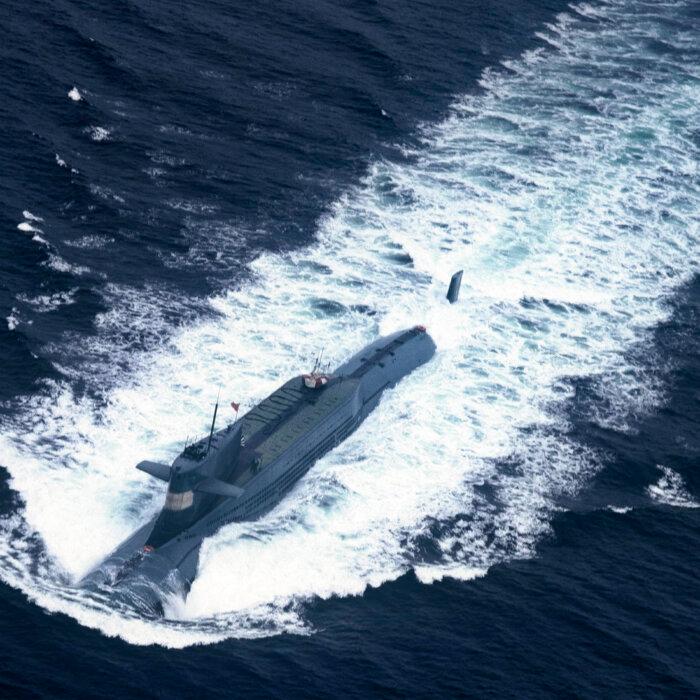
In this photo released by Xinhua News Agency, a long-range ballistic missile bursts out of the sea during a test launched from a Chinese nuclear-powered submarines in the South Pacific on July 6, 2026. Li Xiangchao/Xinhua via AP
The CCP embassy in Canberra gave Australian officials about two hours’ notice before the People’s Liberation Army (PLA) launched a long-range ballistic missile into the South Pacific in July, a Senate Estimates hearing has heard.
Sarah deZoeten, who heads the Department of Foreign Affairs and Trade’s (DFAT) defence and national security policy division, told the committee on Oct. 28 that the embassy contacted departmental officials on July 6, the day of the launch, while Chinese military officials conveyed the same information in Beijing.
Notices to pilots issued on July 5 and 6 warned only of “hazardous operations or space debris,” she said, without providing further details.
DeZoeten said the Chinese Communist Party’s (CCP) notification of the test fell short of the transparency standards outlined in the Hague Code of Conduct, a voluntary international arrangement aimed at improving transparency around ballistic missile launches.
China is not a signatory to the code and has not committed to following its provisions.
Related Stories

Asked by Liberal Senator Jessica Collins whether Australia had warned Pacific governments about the launch, Wong said, “I was in Suva with the prime minister to sign the Vuvale Union and the Ocean of Peace Alliance,” adding, “So you can draw the inference.”
Wong did not specify which Pacific governments had been notified.
Officials would not say whether they thought the timing of the launch was coincidental.
Wong Spoke With CCP Foreign Minister
“We emphasise the importance of transparency and reassurance of intent, and we regard the missile test as destabilising, and we note the expressions of concern, the strong expressions of concern from many Pacific leaders,” she said.
Nauru Missing From Pacific Statement About Test
The statement did not name China, and Nauru distanced itself from it.
Asked why Nauru had taken a different position, Elizabeth Peak, who heads the Office of the Pacific, said that “would be a question for Nauru,” adding that no forum member had told Australia it had been pressured by China over its position.
DeZoeten said Australia had also joined 39 other countries in a U.S.-led statement at the United Nations Conference on Disarmament, which said tests conducted without sufficient warning were dangerous and raised the risk of miscalculation.
Asked whether the CCP had signalled further tests, DFAT Secretary Jan Adams said, “Not to my knowledge.”