





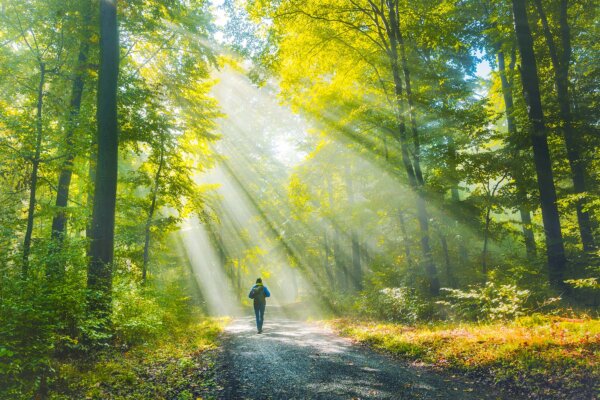
You’ve likely noticed it: You step into a forest, stand by the ocean, or pause beside a stretch of trees—and something shifts. Your shoulders loosen. Your breathing slows. The mental noise softens.
That calming effect can feel almost automatic—which may be why people have been turning to nature when they need a break for centuries.
Only now are scientists beginning to map, in precise neurological detail, exactly what’s going on inside the brain during those types of experiences.
A scoping review of more than 100 peer-reviewed brain-imaging studies, published in Neuroscience & Biobehavioral Reviews, offers one of the most comprehensive neurological pictures yet of how nature affects the human brain.
The results showed that exposure to nature doesn’t merely feel restorative—it triggers a measurable cascade of changes that quiet the brain’s stress circuitry, replenish depleted attention, and produce neural states that closely resemble those seen during meditation.
A Cascade Toward Calm
The review, which drew on studies ranging from real-world outdoor exposure to laboratory photos and videos, immersive virtual reality, and indoor greenery, found a consistent pattern across methods and neuroimaging techniques: Natural environments shift the brain toward a calmer, more regulated state.
Constanza Baquedano, the study’s corresponding author and an assistant professor of psychology at Universidad Adolfo Ibáñez in Chile, told The Epoch Times the team proposes that nature’s effects on the brain unfold in a cascade across several interconnected levels, though she frames this as a working model rather than settled science.
“These levels interact dynamically: Sensory features of nature initiate the cascade, which then propagates through stress regulation, attention, and ultimately how we experience ourselves,” she said.
First Level: What Your Eyes Are Doing
The first stage of the cascade begins with how the brain processes what it sees. Natural environments contain patterns such as fractals—self-similar structures seen in leaves, tree branches, and coastlines—that the brain can process efficiently. Because these structures align with how the visual system organizes information, they require less effort for the brain to interpret. “This reduces perceptual load in early sensory areas like the visual cortex,” Baquedano said.
Studies suggest that the visual characteristics of nature can influence how strongly the brain responds. Scenes with deeper green tones and more coherent natural layouts have been linked to stronger relaxation and mental restoration, while fractals and other natural patterns appear to promote brain activity associated with relaxed attention and meditative states.