





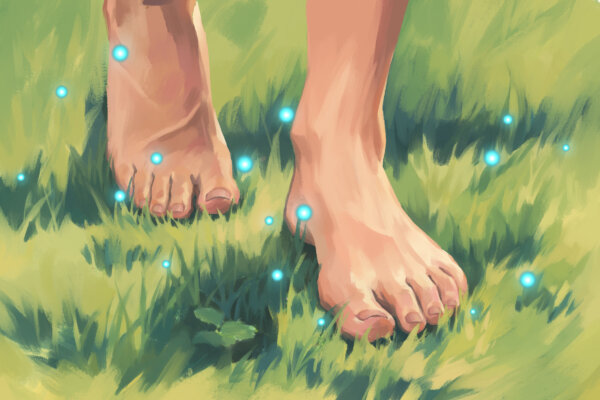
What if simply walking barefoot could have profound effects on how we feel and function?
As we spend more of our lives indoors, in shoes, and on devices, grounding—sometimes called “Vitamin G”—has emerged as a growing area of interest. However, grounding isn’t a new practice. For thousands of years, people have maintained an intimate relationship with the Earth. More recently, research has been exploring whether grounding may offer a range of health benefits.
Grounding, also called earthing, is the practice of reconnecting the human body with the Earth. For much of human history, people were almost always in contact with the ground by walking barefoot, sleeping on the ground, or wearing animal skins as footwear. Modern rubber-soled shoes and insulated buildings have largely reduced that contact.
The central hypothesis behind grounding is that direct contact with the Earth’s surface allows the body to interact electrically with the Earth’s natural electrical environment. Contact with the ground lets the body’s electrical potential equalize with the Earth’s, which may help stabilize the electrical environment surrounding cells, tissues, and organs.
One proposed mechanism is that electrons from the Earth’s surface enter the body and are theorized to neutralize reactive oxygen species (ROS)—unstable, oxygen-containing molecules that damage cells when they build up. ROS are produced naturally, but they spike sharply during injury or infection, when immune cells such as neutrophils and macrophages release bursts of them to fight pathogens. That’s useful in the short term, but ROS that remain elevated for too long can contribute to chronic inflammation. Over time, this may lead to certain chronic diseases.
Preliminary research suggests that grounding improves sleep quality and duration while reducing sleep disturbances, stress, and fatigue.
-
Better Sleep: A 2025 pilot study had 56 people use either a grounding or nongrounding mat for six hours a day for more than 31 days. The grounded group reported better sleep quality, fewer insomnia symptoms, less daytime sleepiness, lower stress, and more total sleep time.
-
Enhanced Autonomic Function: “Your feet are your main interface with the ground and the major source of information for your nervous system,” Mark Morningstar, a chiropractor, told The Epoch Times. A 2017 study of 26 infants in a neonatal ICU found that electrically connecting infants to the ground using a small conductive electrode patch attached to the skin reduced their skin voltage by about 95 percent and increased a marker of vagal tone (a component of heart-rate variability) by 67 percent. The researchers suggested that the electrical grounding could potentially improve stress resilience in preterm infants, although further research is needed.
-
Improved Mood: In a 2015 pilot study of 40 people, one hour of grounding improved positive mood, while the sham-grounded group showed no change—suggesting an effect beyond simple relaxation.
-
Less Pain: In a small 2018 study, 16 massage therapists with pain, fatigue, and depression reported improvements in all three after six weeks of grounding, plus better physical function and energy, some of which persisted one month after the study.
-
Improved Blood Flow: A 2012 review suggested that grounding may help reduce inflammation, decrease the tendency of red blood cells to clump together, and support healthier blood flow by reducing blood thickness.
-
Quicker Exercise Recovery: A 2019 study of healthy adults using grounding sheets found potential reductions in muscle soreness, muscle damage, and inflammatory responses following exercise.
-
Reduced Muscle Damage: In a 2015 study, 32 healthy young men did 200 half-knee bends and were then either grounded or sham-grounded for four hours on two days. The grounded group had smaller increases in creatine kinase, a marker of muscle damage.
-
Wound Healing: Preliminary research links grounding to reduced pain and changes in immune cell counts and inflammatory markers after muscle injury.
Grounding may also influence blood viscosity, heart-rate variability, and blood pressure.
-
Reduced Blood Thickness: A small 2013 study involving 10 healthy adults found that two hours of grounding increased the electrical charge on red blood cells and significantly reduced their tendency to clump, changes the authors linked to potentially lower blood viscosity and cardiovascular risk.
-
Heart-Rate Variability: A 2011 study of 27 participants found that grounding improved heart rate variability more than relaxation alone did, suggesting a possible benefit to autonomic and cardiovascular function.
-
Lowered Blood Pressure: In a 2025 study, 32 older adults with hypertension grounded for 30 minutes, three times a week, for three weeks and saw average drops of 7.81 millimeters of mercury (mmHg) in systolic blood pressure and 2.66 mmHg in diastolic blood pressure. This suggests that the cardiovascular system was under less pressure. No control group was used, so this shows an association, not proof of cause.
-
Enhanced Sensory Processing: Neuroscientist Ramon Velazquez told The Epoch Times that walking barefoot forces the nervous system to continuously track pressure, joint position, and balance. “Shoes normally dampen much of that information,” Velazquez said in an email. “For someone whose day consists largely of screens, chairs, and repetitive environments, barefoot movement creates an unusually dense stream of bottom-up sensory information. That can compete for attentional resources otherwise occupied by rumination.”
-
Improved Cognitive Function: In a 2024 study of 59 adolescent boys, barefoot walking was associated with faster cognitive processing, improved concentration, and changes in brain-wave activity compared with walking in sneakers. However, the study did not isolate electrical contact with the Earth as the cause.
-
Stronger Foot Strength: Barefoot and minimalist-footwear exercise may strengthen the feet through mechanical loading and increased muscle use. A 2025 systematic review of seven studies involving 213 healthy and athletic adults found possible improvements in foot-muscle development, arch function, toe-flexor strength, and neuromuscular control. These benefits relate to barefoot movement and training and should not be interpreted as evidence for the proposed electrical effects of grounding.
Ancient medicine such as Traditional Chinese Medicine (TCM) has a unique take on grounding. Shu Rong, a certified TCM practitioner and director of Doctor Rong TCM Clinic in Cambridge, England, told The Epoch Times that TCM believes that “human beings are born from the qi (vital energy) of Heaven and Earth,” and that they are not regarded as separate from their environment. Grounding allows people to reconnect with nature.
Dr. Tracy Latz, an integrative psychiatrist with 25 years of daily earthing practice, told The Epoch Times that nature’s own effects—scenery, color, a sense of relaxation—“are modulated differently than earthing,” meaning the two shouldn’t be assumed to work in the same way.
In practice, grounding looks like:
-
Walking barefoot on grass, sand, soil, or mud
-
Lying directly on the ground, such as on grass or sand
-
Swimming or wading in natural bodies of water, such as seas, rivers, or lakes
-
Using grounding equipment, such as mats, sheets, socks, patches, or blankets when direct outdoor contact isn’t practical
For those who want to incorporate grounding into their daily lives, it doesn’t necessarily have to feel like another item on the wellness checklist. Everyday moments of contact with the Earth—such as casually strolling over a patch of grass or soil—can be opportunities to ground while spending time outdoors.
Dr. Anna Cabeca, a triple-board-certified OB-GYN, recommends starting with 10 to 15 minutes of barefoot walking on grass, sand, or soil a few times a week. “Pay attention to how you feel; whether you sleep better, feel calmer, or notice changes in discomfort.”
For a more serious practice, Latz recommends working up to more: “Earthing/grounding is the practice of connecting the bare skin of a well-hydrated person directly or indirectly to the surface of the earth for at least 50 minutes a day.”
Indirect grounding can involve grounding sheets or mats:
-
Choose a sheet or mat woven with conductive fibers—typically carbon, silver, or stainless steel.
-
Connect the sheet or mat with a cord to the grounding port of a wall outlet or, if needed, to a grounding stake placed in the Earth.
-
Place the sheet on your bed or mat under your desk, connect the cord, and plug it in.
-
Use an outlet tester first because some three-pronged outlets may not be properly grounded.
A key concern about grounding products’ usefulness is whether they maintain their conductivity over time. Silver fibers can oxidize and gradually lose conductivity without any visible signs of wear, while stainless steel fibers are more resistant to oxidation. However, manufacturers don’t appear to publish long-term or post-wash conductivity data, making it difficult for consumers to verify a product’s performance over time.
Grounding is low risk for most people, but a few groups and situations call for care:
-
Outdoor Exposure: Direct contact with the ground carries ordinary outdoor hazards, including cuts, burns, insect bites, allergens such as pollen, contaminated soil or water, pesticides, and sharp objects. Exercise extra caution with direct earthing during pregnancy, as exposure to soil may involve contaminants or infectious organisms.
-
Grounding Equipment: Grounding mats, sheets, and other products should be properly designed and connected to minimize electrical risks. Always follow the manufacturer’s instructions, and never connect grounding equipment directly to household electrical wiring. Have an electrician verify that outlets are properly grounded and safely wired before using these devices. Avoid grounding devices during thunderstorms, as lightning can create an electrocution risk.
-
Swimming-Based Grounding: Risks related to swimming include waterborne illness, swimmer’s ear and shoulder injuries, drowning, chlorine-related problems such as dry skin, eye irritation, and hair damage, and open-water hazards such as currents, bad weather, and animal attacks.
-
Implanted Devices: Anyone with a pacemaker, insulin pump, or similar device should check with their doctor before using grounding equipment to rule out interference.
Shu added that people who have cold hands and feet may not be suitable for grounding. “Someone with a relatively warm constitution may find barefoot walking on grass or sand refreshing and calming in warm weather,” said Shu. However, a person with a cold body constitution “may be adversely affected by prolonged contact with cold or damp ground.”
Grounding, as a wellness practice, is still being studied. But the broader idea behind grounding—reconnecting with nature—is meaningful.
“Spending time outdoors, moving the body, calming the mind, and living in greater harmony with natural rhythms can all form part of a healthy lifestyle,” Shu said.