





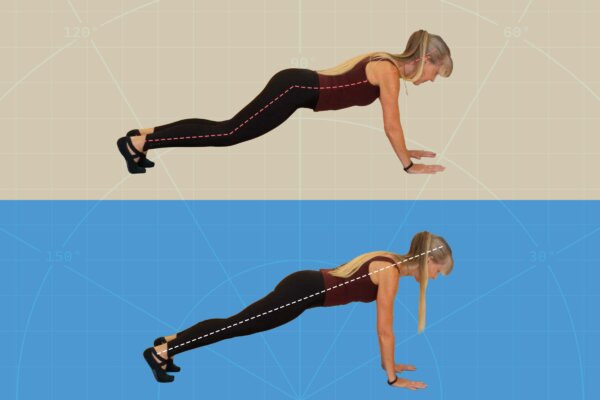
The classic plank exercise involves a sustained postural hold—the weight of your body is supported on your hands and feet, with your trunk muscles keeping your trunk straight. It’s a powerful exercise that works your core, shoulders, back, glutes, and legs in a stationary hold.
That’s a bundle of muscles working all at the same time, which is why the plank exercise is so effective. The plank is considered a closed-chain exercise and is extremely low-impact in nature, making it beneficial—and accessible—to almost everyone.
Benefits of a Properly Done Plank
Convenience: You can do a basic plank almost anywhere, as long as you have a firm, flat surface. It doesn’t require special equipment or advanced physical ability. You simply move into a position and hold it.
Core Strength: Due to its intense activation of your core musculature, the plank can serve as almost a single-source exercise for increasing your core strength.
Postural Benefits: Because the plank exercise strengthens muscles from your shoulders down through your legs, it fosters enhanced trunk control and postural support, especially in standing.
6 Common Plank Mistakes
The classic plank movement primarily engages your rectus abdominis—your “six-pack”; transverse abdominis—the deepest of the “flat” muscles that act somewhat like a muscular corset; the internal and external obliques—the outermost of the lateral muscular layers.
Plank also involves the quadratus lumborum muscles, which are structurally part of the abdominal muscles but functionally aligned with the back muscles and contribute to lateral trunk flexion and trunk extension, and the erector spinae muscles, which are a group of three large, deep back muscles that primarily function in back extension and stabilization.
Your gluteal muscles and the quadriceps muscles of your legs help stabilize your position from the lower half of the body, while your deltoids, trapezius, rhomboids, triceps, biceps, latissimus dorsi, and other muscles help stabilize your upper half.
Some of the most common elements of poorly done planks are:
1. Misaligning the Arms: Your arms should be straight up and down with your hands directly beneath your shoulders.
2. Piking or Raising Hips: Your hips should be in line with your back. Raising your hips too high reduces the exercise’s effectiveness and puts increased strain on your shoulders.
3. Bending Knees: Allowing your knees to bend while performing the activity makes it easier, but keeping your knees straight maximizes the benefit for your core muscles.
4. Sagging Back: Sagging your back reduces engagement of your spinal stabilizers and back trunk muscles and can decrease the exercise’s effectiveness.
5. Hanging From Shoulders: Letting your upper body sink brings the shoulder blades close together and allows them to retract. It also reflects poor core engagement.
6. Chasing the Clock: It’s common, especially in the early days of performing this exercise, to try to keep performing the activity even though your strength has decreased enough that you aren’t able to hold good form any longer. Hold the position only as long as you can control the movement.
Let’s discuss how to perform proper plank movements.
Proper Plank Technique
Follow this simple guide to perform planks with good form:
Starting Position
The starting position for the standard plank is with your hands and knees on the floor, with your knees and feet approximately hip-width apart.
Planks Step-by-Step
-
Step your feet back to a push-up position, with your elbows straight and your hands directly below your shoulders.
-
Keep your knees straight. Your entire body should be in a straight line from your shoulders to your feet, and your head aligned with your spine.
-
Engage your core to maintain the position.
-
Hold the position for up to one minute, and try to perform five total one-minute planks.
Variations
Considerations
Here are some of the considerations to think about while performing planks:
-
If you struggle to hold the position during the plank, only hold it as long as you can in good form before lowering back down and relaxing.
-
Many people demonstrate a tendency to hold their breath during this exercise. Maintain a slow, steady rate of breathing during task performance.
-
You can do a plank with your knees on the ground at first if you can’t rise into a proper plank, but only use this format as much as you need to, continuing to try to move into the proper form over time.
-
Limit sets to a max of only five planks at first, even if you feel you could do more. If your body tolerates these well, feel free to carefully add more planks or hold them longer to make them more challenging.
I hope you now have a better understanding of the classic plank and how it benefits you. I recommend doing them at least three times per week, and ideally five times per week. Good luck, and I hope they work well for you.
About the Fitness Model: Aerowenn Hunter is a health editor for The Epoch Times. She is an accredited yoga therapist with more than three decades of teaching experience.