





Protests over rising living costs and education funding have swept major French cities over the weekend
Nearly 350 people were arrested in Paris on Sunday and overnight amid violent unrest sweeping France despite President Emmanuel Macron’s appeals for calm, the authorities said on Monday.
Hundreds of thousands protested rising living costs and education funding cuts over the weekend, with demonstrations escalating into clashes with police, arson and looting.
The violence erupted Saturday as Yellow Vest demonstrations merged with student protests that began last month at a high school in Creteil, near Paris, over teacher shortages and deteriorating facilities. The movement has since broadened into protests against inequality and rising living costs, with labor unions joining in opposition to the government’s proposed 2027 budget and spending cuts.
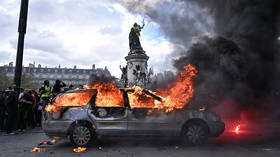
Despite Macron’s Friday appeal for “calm and respect,” Paris endured two days of rioting. On Sunday, protesters clashed with police near Place de la Republique as vehicles and trach cans burned, shops were looted and officers deployed tear gas and water cannons.
Footage showed charred wreckage, shattered storefronts, smashed advertising signs and graffiti-covered businesses.
🇫🇷 Paris? Its looks like a third world country 😢
Writer: Samuel https://t.co/rbd0fwCwm6— Mario Nawfal (@MarioNawfal) October 19, 2026
A crowd also attacked RT Arabic correspondent Wafa Fakkani while she was filming the protests. Her cameraman captured the incident before the crew escaped and resumed reporting.
A day prior, violence hit some of the capital’s wealthiest shopping districts, where luxury retailers were targeted by vandals and looters. Paris Mayor Emmanuel Gregoire said “entire streets” had been “systematically devastated.”
Galeries Lafayette in Paris is being looted tonight.
It’s the French equivalent of Harrods in London or Bergdorf Goodman in NYC https://t.co/F5jZU4bswZ— Visegrád 24 (@visegrad24) October 17, 2026
Clashes also erupted in Marseille, Lyon, Lille, Bordeaux, Angers, and Limoges, damaging businesses and public buildings. Alain Di Crescenzo, head of the CCI France chamber of commerce network, estimated that more than 2,000 businesses were affected, with damage reaching “hundreds of millions of euros.”
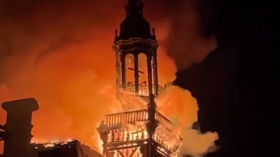
Justice Minister Gerald Darmanin put nationwide turnout at 550,000, including 110,000 in Paris, while organizing trade unions, including the CGT, and student groups estimated that 800,000 people took part. Darmanin told France 2 on Monday that, in total, more than 2,330 people had been detained over the weekend, including around 855 in the capital. Nearly 1,000 police officers and gendarmes were reportedly injured.
Although the worst rioting had subsided by Monday morning, students and union activists blocked access to the iconic Louvre Museum, denouncing “police repression.” Footage showed demonstrators gathering outside the museum’s glass pyramid after passing security, prompting its temporary closure.
🚨🇫🇷 ALERTE INFO !
“ACAB, ACAB, ACAB !”
Devant la pyramide du Louvre à Paris, des étudiants d’écoles d’art et de culture manifestent et bloquent l’entrée du musée.
(@JBSemerdjian / Le Figaro) https://t.co/zpH7KcHPX4— Impact (@ImpactMediaFR) October 19, 2026
Action and reaction
Politicians across France’s political spectrum blamed Macron and his government for the unrest, accusing the administration of undermining public services and failing to maintain order.
Marine Le Pen, who leads first-round polling for the 2027 presidential election, called Macron a president “without credibility or authority,” describing his administration as “a government on its last legs.” Jean-Luc Melenchon, leader of the left-wing France Unbowed party, blamed “ten disastrous years” of Macron weakening public services. The mayors of Paris, Marseille and Limoges accused Interior Minister Laurent Nunez and police commanders of incompetence in maintaining public order.
Nunez initially blamed “opportunistic troublemakers” for the unrest, but admitted Monday that police had suffered “a loss of control” due to poor planning. He said he offered his resignation Sunday, but Macron refused, instead ordering a new policing strategy, faster deployment and transparency over intelligence failures. Prime Minister Sebastien Lecornu ordered partial curfews in several cities.
Macron condemned the rioting, insisting there was “no place for violence” and promising punishment for vandals and looters. In a televised address Sunday, he said “nothing justifies” the destruction, but pledged to address students’ complaints over school conditions. Meanwhile, he portrayed the unrest as an attempt by political opponents to disrupt the democratic process and influence voters ahead of the presidential election in six months.
Despite the unrest, Macron departed on Monday for a three-day visit to the Middle East, leaving his government to deal with the fallout at home.
The crisis comes as Macron’s approval ratings hit record lows. An October Ipsos BVA-CESI poll for La Tribune Dimanche put his approval at 15%, with 82% disapproving, the lowest since he took office in 2017. An Ifop survey recorded 17% approval and 83% dissaproval. Le Pen leads first-round polling for the April 2027 election with 32-36% support.
Protests spread beyond France
France was not alone in facing unrest over the weekend, as tens of thousands protested living costs, housing shortages and government policies across Europe. Demonstrations in several countries escalated into clashes, vandalism and arson.
In Belgium, students opposed rising education costs and reforms they say threaten access to higher education. In Italy, marches against living costs and wars turned violent in Milan and Bologna. In Portugal, tens of thousands protested low wages, rising rents and housing shortages. In Albania, student-led protests entered a fifth day, with demonstrators demanding Prime Minister Edi Rama’s resignation over corruption allegations, unemployment and poor prospects for young people.
Former Austrian Chancellor Sebastian Kurz described the unrest across Europe over the weekend as resembling “scenes from a civil war,” warning in a post on X that “we risk seeing the same scenes soon in Berlin, Vienna and Munich.”
Kremlin spokesman Dmitry Peskov described the European unrest as “bordering on chaos,” calling it a major crisis.
“It’s hard to say whether the crisis is systemic or not, but it is obvious that it is a big crisis,” he told reporters on Monday.
Some experts who spoke to RT linked the unrest to EU’s confrontation with Russia. Italian journalist Davide Carbonaro called the severing of economic ties with Moscow “economic and political suicide,” saying that young Europeans felt betrayed and deprived of a future. Serbian journalist Nebojsa Malic accused Western leaders of scapegoating Russia to hide their failures.
RT’s Chay Bowes examined how Europe’s continued support for Ukraine and sanctions against Russia are fueling economic pressures and public discontent as unrest spreads across the continent.