





Australian home builder Scott Challen estimates about 90 percent of the materials used in building his houses come from China.
Despite the low cost of Chinese supplies and the benefits to the profit margins of Australian businesses, Challen says its time to overhaul Australia-China trade ties and even consider tariffs to protect local manufacturing.
Challen runs the QHI Group, which builds primarily in the south-east corner of Queensland. He also runs a multi-million-dollar online business that sells building supplies across the country.
“If you have a look at a house, 90 percent of what goes into a house [in Australia] comes out of China,” he told The Epoch Times.
“Steel frames, cladding, insulation, screws and fixings, electrical cables, all of it,” Challen says. “With the exception (probably) of the dirt and lime that goes into the concrete.”
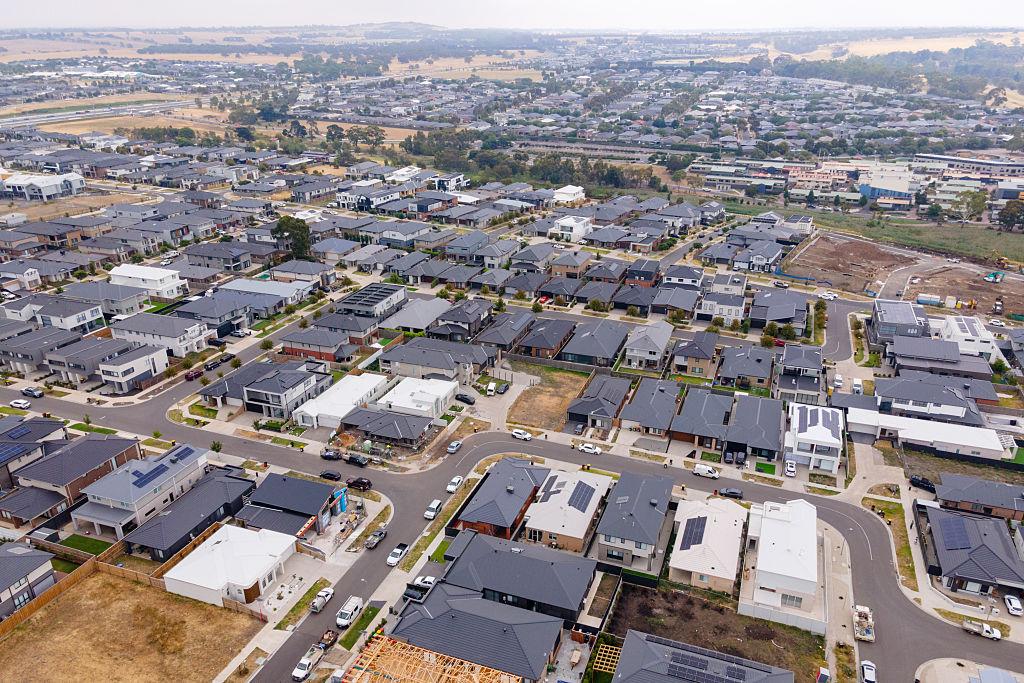
New houses line the streets of an outer suburb in Melbourne, Australia, on Jan. 13, 2026. Jesse Thompson/Getty Images
Challen also runs The Australian Lobby Group, which organises the Australian Marches events across the country against mass migration. The Group also acts as a lobby group in Canberra on behalf of the public, rather than industry interests.
Related Stories

One of its focuses is banning foreign organisations from lobbying in Canberra.
Australia Imports $130 Billion Worth of Manufactured Goods From China
“The China-Australia Free Trade Agreement should never have been signed,” Challen warns. “It’s made us very dependent on one trading partner.”
“Australia needs to drill, dig, and use its resources. Define our own sovereign capacity when it comes to those things, recreate our manufacturing industries, and not rely on immigration when it comes to propping up the economy,” he said.
The Epoch Times contacted the Housing Industry Association (HIA) for an assessment of Challen’s home building figure.
The organisation pointed to ABS data that shows that China accounted for a sizeable portion of key import categories linked to the building industry:
-
62 percent of imported clay constructions materials and refractory construction materials;
-
53 percent of glass;
-
49 percent of nails, screws, nuts, and bolts;
-
41 percent of hand tools;
-
35 percent of electrical switches and wire imports;
-
34 percent of floor coverings; and
-
19 percent of simple wood products.
Challen says renegotiating free trade deals—not just with China—may be the best way forward to rebuild Australia’s domestic manufacturing capacity, particularly in steel and construction materials.
“You aren’t going to have Australian manufacturing and industry without tariffs,” he said. “Tariffs have to be the one thing that protects and defends your economy.”
When asked which products he would target, Challen pointed to steel and value-added building products.
He says he tries to use Australian-made steel, but that becomes more difficult with each year that passes as prices for local products soar.
“It’s never been harder to be supportive of Australian industry than it is now,” he said.
An HIA spokesperson said they support the principle of local manufacturing, praising the federal government’s $150 million investment in the local forestry industry.
“Seeking the lowest cost products from overseas can leave a country vulnerable to international events,” the spokesperson told The Epoch Times, but they also warned of trade-offs.
“Trying to become ‘self-sufficient’ in products that other countries are better suited to produce and/or diverting resources from more productive Australian industries, also carries a cost for Australia.”
Trump Tariffs on Forced Labour Forcing a Rethink
While the topic may be uncomfortable for Australian decision-makers, current circumstances could warrant a renewed focus.
On July 24, the Trump administration imposed a 12.5 percent tariff on most Australian goods exported to the United States.
The tariffs followed investigations that found Australia, among other countries, was not doing enough to root out forced labour in product supply chains.
An example of how this relationship works is the participation of ethnic Uyghur slave labour in China’s western Xinjiang Province in the production of polysilicon for solar panels. China is Australia’s number one source of solar panels, in turn, China is the world’s top manufacturer of solar panels.
It’s a situation that has compelled Australian Anti-Slavery Commissioner Chris Evans to renew calls for stronger laws against forced labour.
“To change how business operates every day, we also need a clear legal obligation on large companies to take reasonable steps to find and fix modern slavery risks,” he said on Oct. 15.
However, Challen says it would be “impossible” to truly identify whether forced labour has contributed to a product.
“A certificate saying ‘ethically sourced’ doesn’t necessarily establish anything about upstream workers … It’s highly likely we’ve got a high number, a high percentage, of imported building materials that come from forced labour.”