





From a small Italian town to leading fashion houses like Benetton and Prada, Manuela Fabris says that decades on, iconic brands may have lost something more valuable than market share—their identity.
From a young age, Fabris was guided by a search for beauty.
Having trained at one of Italy’s top fashion schools in Milan, Fabris says modern fashion houses have stopped searching for their “soul” and are now chasing revenue and growth.
“When major brands were still led by their founders, a fashion house used to ‘look within,’” she said.
“And when a brand stops searching for its ’soul’ and begins simply protecting its acronym, it can continue to grow for a while. But it slowly loses the heart that made it alive and necessary.”
From a Small Town to Milan
Fabris grew up in Povoletto a small town in northeastern Italy.
After finishing art school in Udine, Fabris attended Istituto Marangoni in Milan, one of the world’s top fashion schools, where major designers for brands like Dolce & Gabbana went.

Senior Italian fashion designer who trained in Milan and worked in major brands like the United Colors of Benetton and Prada. Courtesy of Manuela Fabris
Marangoni was a college attended by the wealthy heirs of global fashion companies where students’ futures were already mapped out, but Fabris was different, she had no connection to the fashion industry.
Related Stories


Despite the expensive fees, her family supported and encouraged her but sternly told her to complete the course “out of respect for yourself, your parents and the money spent.”
Touched by Valentino, a Chance With Benetton
After graduating, Fabris searched for job opportunities and sent her CV to all Italian brands.
“I still have a beautiful letter, signed by [fashion designer] Valentino, to whom I had sent some drawings and sketches. He had personally viewed them and thought I was very talented. He didn’t need more staff, but he advised me to persist,” she said.
And persist she did, at times working for free, determined to gain experience and establish her name.
Her most significant internship was at Napapijri—a new Italian sportswear brand, famous for its technical textiles and innovation.
“It was a beautiful brand, all made in Italy, of exceptional quality. I worked there for a year,” Fabris said.
One day, while reading Gulliver, the Italian version of National Geographic, she found a competition organised by global brand, the United Colors of Benetton.
The participants were to design a jacket reflecting the magazine’s values. The three winners were offered some money and an internship.
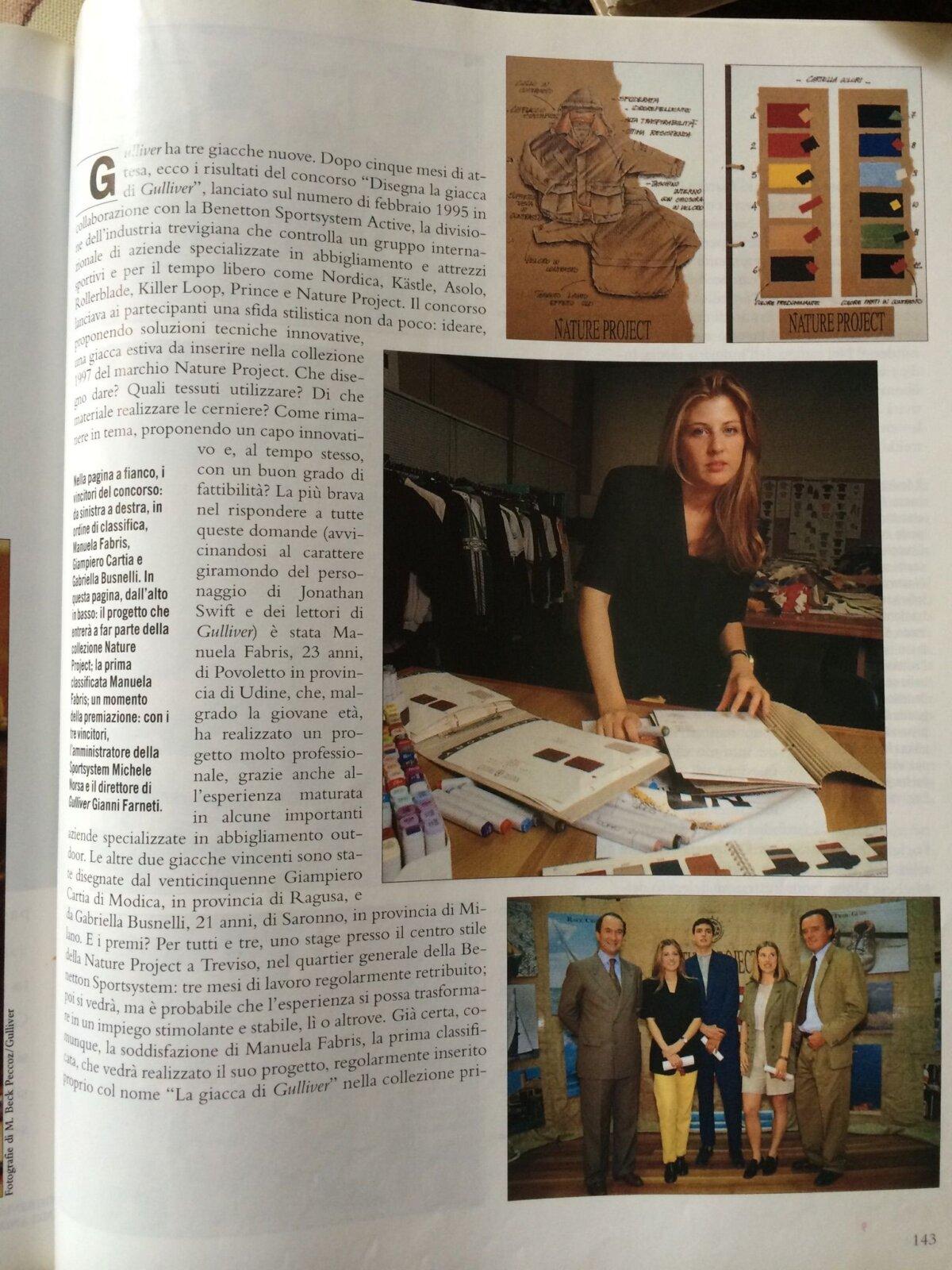
A copy of Italy’s Gulliver magazine featuring a competition by the United Colors of Benetton, which Fabris managed to win by designing the winning jacket. It was the first big step in her career. Courtesy of Manuela Fabris
Fabris came first, marking a big step forward in her career. After six months of internship, she was employed.
“School can give you some knowledge, but places like Benetton were the real school for me. We were all young, and that was wonderful, a huge, vertically integrated company.
“In Argentina, they had wool and cotton production. They had their own companies that manufactured fabrics and clothing, prototyped, embroidered, and printed, and it was all around Treviso (Veneto, Italy).”
Benetton was the first to invent the concept of colourless “ready-to-dye” clothing, which could be dyed according to the most popular colour at the time. For example, when pale yellow was in fashion rather than pink or fuchsia, designers could dye clothes on the spot.
“Within 15 days, a garment was ready for sale, making the company ahead of all the brands that took six months to go from design to sample,” Fabris said.

Fabris also helped design Benetton’s Formula 1 race collection. Courtesy of Manula Fabris
The Devil Wears Prada?
Fabris says her skill at combining fashion with practical wear eventually attracted the attention of Prada.
“[Prada] needed a stylist who came from the real world, from the technical world,” she said, a position she eventually accepted as a style manager.
While the movie, The Devil Wears Prada, personified the cut-throat and high-pace nature of the fashion industry, Fabris says it “pales in comparison” to the real thing.
“It was tough … when you’re inside these large fashion companies that have become international brands, you find people who have lost themselves, confusing their own lives with the identity of the brand,” she reveals.
“Everyone says ,‘We are Prada,’ and any sacrifice is justified; you work at any hour of the night and on weekends, because ‘you are Prada.’ Everyone is very ambitious.”
Commercialism Over ‘Imperfection’
Yet, this is where Fabris says, after years in the industry, major fashion houses are losing a bit of what made them special.
Financial metrics weigh heavy on the minds of company managers, and that can also mean playing it safe.
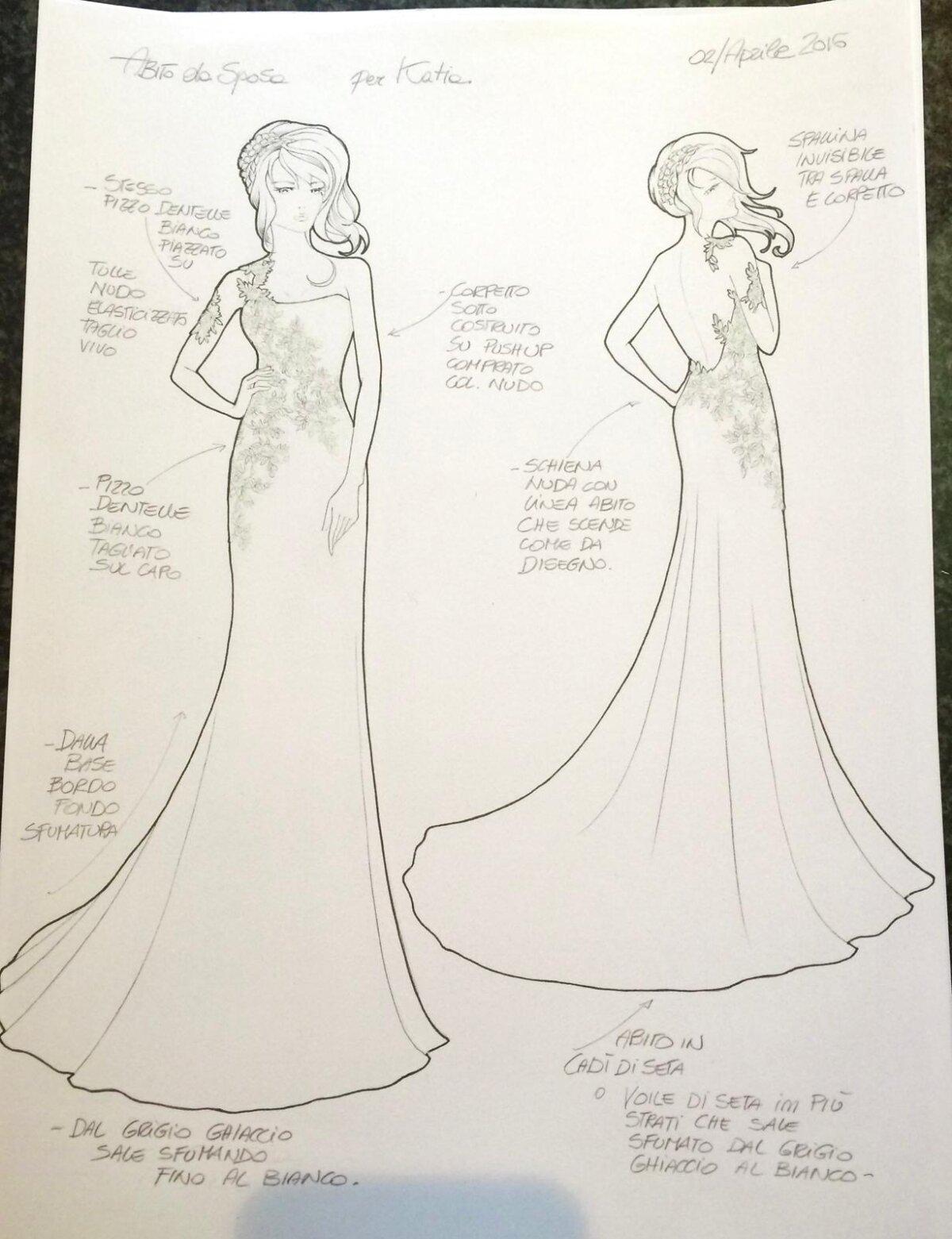
A wedding gown design by Fabris for a friend. Courtesy Manuela Fabris.
“Same faces, same emotional distance, same flaunted wealth, same perfectly illuminated boredom, and same cold beauty,” Fabris says. “Everything is elegant and controlled, conforming to an international format, but often lacks a true identity—the DNA.”
Fabris added that style is “not the absence of error;” rather it is the ability to understand which “imperfection” to leave alive.
“Real style happens when a vision manages to transform a small freedom into identity,” she said.
“Beauty, on the other hand, is the moment when the outside world touches something special within us, creating a state of well-being, wonder … and peace with the world.”
It’s a point other artists have touched upon too, the beauty of “imperfection” or the human touch.
“Personally, this is my little pushback on AI … if I got onto Photoshop, I could make these look really excellent, but I don’t want to,” Stegert said.
“We’re so used to perfect graphics and everything being so schmick—smooth and slick—that it’s almost lost its humanity. And this type of art, especially when you look at the originals, it has errors in it.
“The lines are wobbly in some places, they’re not perfectly centred. And yet they’re beautiful and amazing, and so they they have this kind of feel to them that says a person created this, not a machine.”
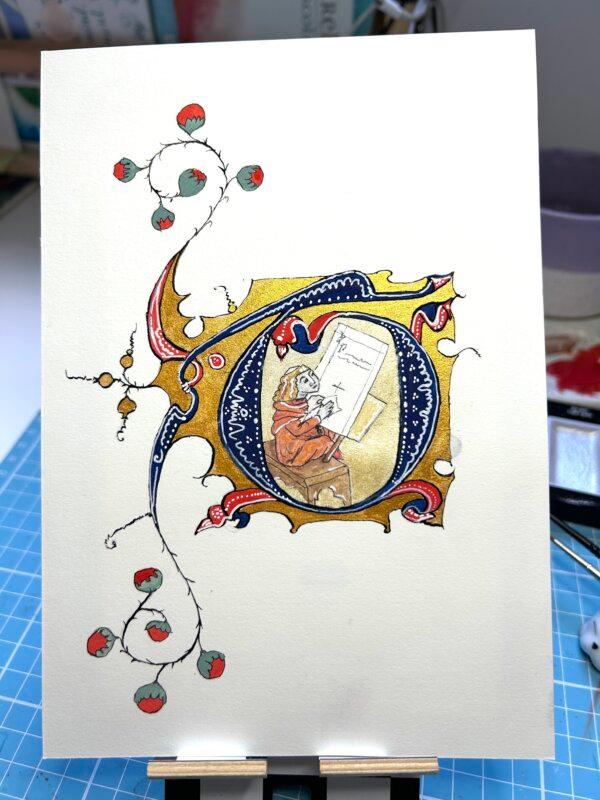
An illumination artwork of the letter “T” by Alison Stegert. Courtesy of Alison Stegert
Meanwhile, author and Epoch Times commentator Jeffrey A. Tucker has been heavily critical of the prevalence of postmodern or minimalist design, which can mirror the sleek designs created by machines.
“It was awful and hideous but perfectly compliant with the postmodern aesthetic. They had even renamed the place,” Tucker said.
He noted the place failed to win over guests and ended up being sold again.
“The new owners restored the old name and the interior, to the point that now it looks better than ever.”
A New Perspective
Meanwhile, one of Fabris’ personal milestones was opening her own studio, which she described as an “uphill battle.”
“But I made it,” she said. “Before, I had to focus solely on doing my job well, then [in my new venture] 80 percent of my tasks were finding clients, doing public relations, processing payments, payroll, opening and closing contracts—all things a pure creative like me had never done.”

Fabris in Hawaii. Courtesy Manuela Fabris.
Fabris said her perspective on life changed.
“We saw seemingly untouchable situations, states, and worlds enter crisis. I remember the collapse of Lehman Brothers; I remember that, in 2009, there were people in California who‘d lost their homes because they couldn’t pay their mortgages. South of Los Angeles, in Huntington Beach, there were miles of campervans and trailers … people who’d lost everything,” she said.
When they rented a house in Bel Air, Los Angeles, they paid “next to nothing,” as the owners had left the property and rented it out to pay off their mortgage—a common sight during the foreclosure crisis in the United States.
“I remember finding everything there, even a picture of their grandmother on the nightstand. We felt like we were living someone else’s life, in a completely different place—and this was special.
Yet through her travels, Fabris now understands the “most beautiful things in life can’t be bought.”
“They are simple and were given to us by God: the beauty of nature, happiness, light … Life should not be wasted; and you know that you’re on the right path when your heart feels well.”