





Somatic therapy begins with a simple idea: the body remembers what the mind tries to forget.
Long after the mind has moved on from a stressful or traumatic experience, the nervous system can still carry its imprint. Somatic therapy invites people to listen to the body’s subtler language—breath, posture, sensation, movement—as pathways toward emotional healing, trauma recovery, and nervous system regulation.
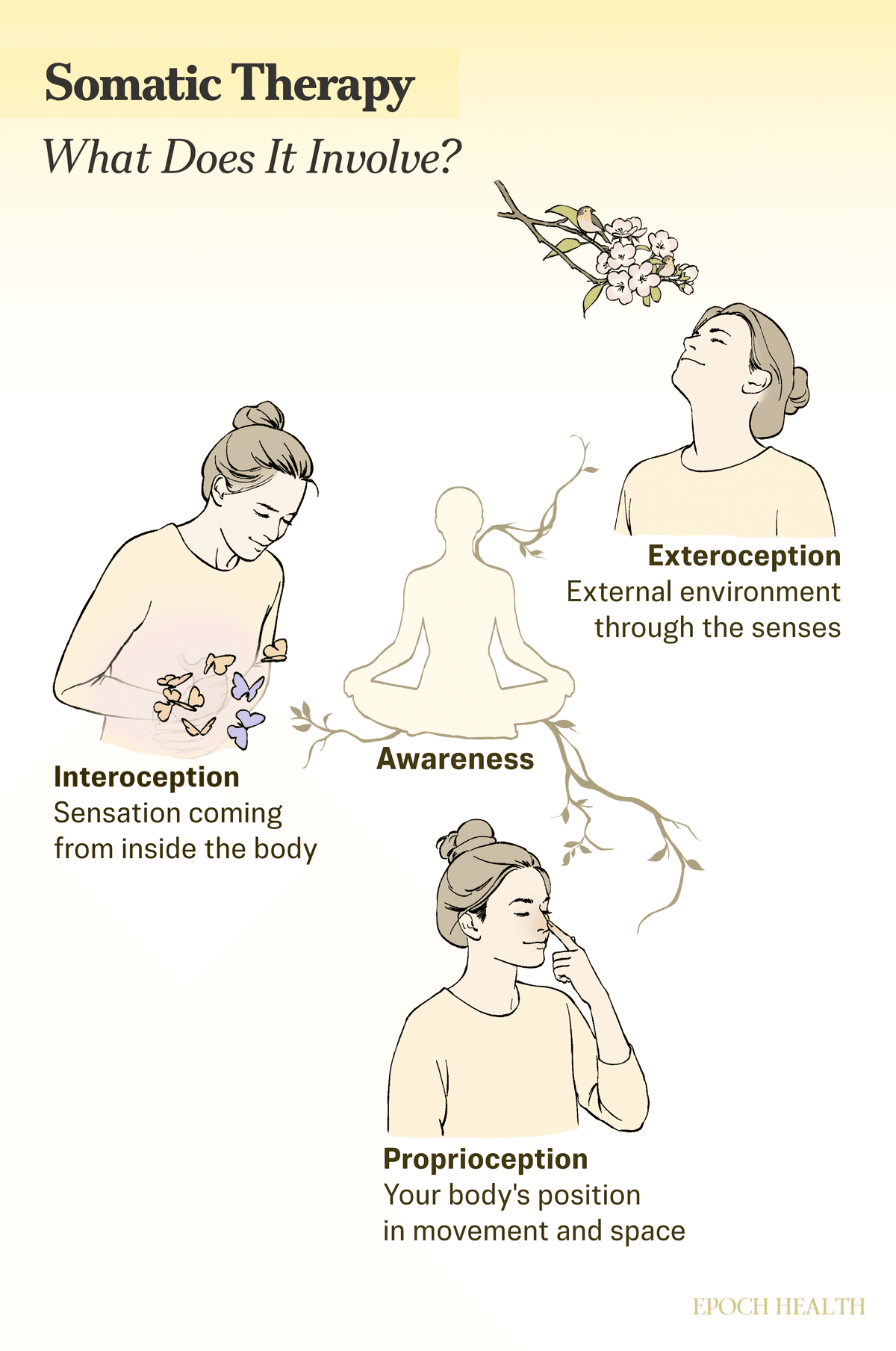
Illustration by Ran/The Epoch Times
Somatic therapy belongs to a family of mind-body approaches, similar to mindfulness meditation, Mindfulness-Based Stress Reduction, and biofeedback, although it remains less mainstream than these practices.
Derived from the Greek word “soma”, which means body, somatic therapy encourages people to tune into physical sensations. Trauma, chronic stress, identity loss, and relational rupture are not just cognitive experiences; they can also show up in the body through muscle tension, breathing patterns, posture, movement, and nervous system responses to perceived threat, Julie Merriman, a professor and program director in graduate counseling education at Northwestern College, told The Epoch Times.
By paying attention to these bodily responses, somatic therapy practitioners believe people can access emotions that may feel “trapped” beneath the surface and begin to release them. Somatic therapy is distinct because it treats the body as the primary site of healing, not simply a secondary route, the way other mind-body approaches do, Merriman noted.
Somatic therapy draws on a century of body-oriented traditions and modern neuroscience. Merriman describes it as a collection of evidence-based approaches united by the belief that lasting psychological change requires engaging the body.
Somatic therapy includes a range of therapies, each with its own approach and strengths.“Key benefits of these therapies include reducing trauma and stress-related symptoms, improving emotional regulation, increasing body awareness, and helping people feel safer and more resilient in their bodies,” Dr. Jeffrey Ditzell, a psychiatrist and performance coach in NYC, told The Epoch Times.
Trauma-related symptoms are thought to arise from disruptions to the body’s basic survival processes, including fight, flight, or freeze. When an experience is overwhelming or inescapable, the nervous system can get stuck in “survival mode,” continuing to signal danger long after the threat has passed. This can show up as anxiety, panic, hypervigilance, or feeling “on edge,” chronic tension or pain, a racing heart, shallow breathing, or feeling numb and disconnected. People with PTSD may also become unusually sensitive to everyday sights, sounds, and other sensory experiences, making harmless situations feel threatening.
Somatic therapy also helps people notice the factors behind their pain. Ditzell notes that it can be a useful support for chronic pain, fatigue, and other somatic symptoms, especially when emotional stress is making physical symptoms worse. Many people report better physical function and less reliance on pain medication.
Common somatic therapies include:
Somatic Experiencing
Sensorimotor Psychotherapy
Sensorimotor Psychotherapy blends traditional talk therapy with insights from neuroscience, mindfulness, and attachment theory, which proposes that the quality of early relationships with parents influences emotional security in adulthood. By connecting body awareness with emotions, thoughts, and memories, it helps people process trauma and developmental experiences and helps with trauma and attachment-related issues such as relationship difficulties, difficulty concentrating (due to unsettling thoughts), and persistent negative self-beliefs.
Emotional Transformation Therapy
Emotional Transformation Therapy helps people process and shift emotions quickly by using “precise visual brain stimulation,” which involves using specific wavelengths of light during therapy. As light enters the eyes, it is converted into neural signals that interact with brain systems involved in emotion, cognition, and physiological regulation. Emotional Transformation Therapy theory proposes that carefully selected wavelengths may help engage the neural mechanisms underlying a person’s distress, potentially supporting rapid relief of psychological and, in some cases, physical symptoms.
Deep Brain Reorienting
Bioenergetic Analysis
Bioenergetic Analysis focuses on releasing chronic muscular tension, sometimes called “armoring,” to restore the free flow of energy through the body. Merriman notes that people often experience profound shifts in posture, breath, and emotional access once these physical holding patterns are released with this method.
Movement and Awareness-Based Therapies
Dance/Movement Therapy lets people express and explore emotions nonverbally through movement, which can be especially helpful for those who find conventional talk therapy limiting.
The Hakomi Method combines somatic awareness with experiential techniques—Ppeople are guided through gentle actions or experiments to observe how their bodies respond and where they hold tension..
Certified somatic movement therapist Angel Howard notes that a key benefit of somatic therapy is learning to notice early physical signs of emotional activation, which allows people to self-regulate before emotions become overwhelming.
Over time, somatic approaches aim to build nervous system resilience by helping regulate both collapse states—such as depression or emotional shutdown—and hyperarousal states such as anxiety, hypervigilance, and panic.
Somatic therapy helps people tune into what is happening both inside and outside their bodies, through three types of body awareness:
-
Interoception: Awareness of sensations coming from inside the body, such as a racing heart before a presentation, feeling butterflies in your stomach when anxious, or recognizing hunger or thirst.
-
Exteroception: Awareness of the external environment through the senses, such as hearing birds singing, feeling the warmth of the sun on your skin, smelling fresh coffee, or noticing the color of a flower.
-
Proprioception: Awareness of your body’s position and movement in space, such as touching your nose with your eyes closed or walking up a flight of stairs without looking at your feet.
To develop these types of awareness and perform somatic therapy, “the majority of somatic movement therapists and professionals use different techniques and exercises, adapted to their own principles and ways of working,” Howard said.
Commonly used techniques include:
-
Body Cueing: Directing participants’ attention to specific sensations, such as muscle tension or breathing patterns.
-
Resourcing: Identifying and connecting with sources of comfort and safety, such as supportive relationships, calming memories, calming places, or personal strengths.
-
Titration: Approaching difficult memories or emotions in small, manageable steps to avoid overwhelm.
-
Pendulation: Gently moving back and forth between feelings of safety and mild activation tied to a difficult experience, building the capacity for discomfort over time.
-
Expressive Movement Exercises: Following bodily impulses such as wiggling, rotating joints, and shaking out tension.
-
Alexander Technique: Correct unconscious posture and movement habits that create tension.
A few simple practices don’t require a therapist’s guidance:
-
Grounding: Grounding practices help bring attention into the present moment by connecting with physical sensations. This may include feeling the body’s contact with the ground (such as bare feet on the earth) or noticing internal sensations such as posture, movement, and areas of tension or ease.
-
Breathwork: Breathwork uses slow, intentional breathing to promote relaxation and support nervous system regulation. A common technique is diaphragmatic, or “belly” breathing, in which the abdomen expands during inhalation and gently contracts during exhalation. This type of breathing can help stimulate the parasympathetic nervous system, or the body’s natural “rest and digest” response, to encourage a greater sense of calm and relaxation.
-
Mindfulness Exercises: Mindfulness exercises encourage focused attention on the present moment without judgment. One example is a body scan, which gradually focuses attention on different parts of the body and notices physical sensations to promote relaxation and reduce stress. Another example is seated meditation, which often involves paying attention to the breath, bodily sensations, or the surrounding environment to cultivate awareness and emotional balance.
Ultimately, by building awareness of bodily experiences and nervous system responses, somatic therapy transforms the body from a source of distress into a valuable ally in the healing process.