





When Connie Chen’s father reached his 80s, his digestion was not what it used to be. His abdomen had become more protruding, and age spots were increasingly visible on his face.
“My father slept well and ate neither too oily nor too bland food, but his digestive system wasn’t as efficient as it used to be,” Chen, director of Jingher Chinese Medicine Clinic, said on “Health 1+1” on NTD, a sister outlet of The Epoch Times.
Chen used traditional Chinese medicine (TCM) approaches to improve his bowel function. About two weeks later, she said, her father noticed that his abdomen had become smaller—and his largest facial age spot had disappeared.
Since 2019, he has paid particular attention to his digestion and metabolism. Now six years older, Chen said, some of his freckles and yellowish-brown spots have actually faded.
“After clearing out the waste from your intestines, the blemishes on your face will decrease significantly,” she said.
Her father’s experience illustrates an idea deeply rooted in TCM: The condition of the skin may reflect what is happening inside the body.
Related Stories

Modern research is now exploring its own version of this connection—the gut–skin axis.
Why TCM Connects the Gut and Skin
In TCM, organs are understood not only by their anatomical functions but as interconnected functional systems. The lung is said to “govern the skin,” while the lung and large intestine are considered an internally–externally related pair.
The complexion is likewise viewed as one of many external clues to the condition of the body’s internal systems. From this perspective, poor elimination and patterns described as intestinal dryness, heat, or dampness may be reflected in changes in the skin.
Treatment therefore focuses on restoring the individual’s overall balance rather than simply removing a visible spot. Depending on the person’s pattern, this might involve clearing heat, resolving dampness, strengthening the spleen, nourishing blood, or moistening the intestines.
Modern medicine describes the relationship very differently, but research increasingly supports the existence of communication between the gut and skin.
These findings do not demonstrate that constipation causes age spots or that bowel cleansing can remove pigmentation. Age spots are strongly associated with aging and cumulative ultraviolet exposure. However, the emerging gut–skin research offers an interesting modern parallel to TCM’s longstanding emphasis on the relationship between digestive health and the skin.
A Traditional Formula for Sluggish Bowels
Chen said she often sees older patients with what TCM describes as “intestinal dryness.” In practical terms, aging can be accompanied by slower intestinal motility, inadequate fluid intake, changes in diet, medications, and other factors that contribute to constipation.
For appropriate patients, Chen recommends Ma Zi Ren Wan, also called Hemp Seed Pill, a traditional formula that has been used for centuries for constipation.
The formula has also undergone modern clinical testing.
Chen may also modify herbal treatment according to a person’s constitution, sometimes adding herbs such as angelica, traditionally used to nourish and promote the circulation of blood.
Because herbal formulas can interact with medications or be inappropriate for certain medical conditions, older adults in particular should consult a qualified health professional before using them regularly.
A TCM Practitioner’s Morning Cleansing Drink
Chen herself has fair and delicate skin. Her secret to maintaining healthy skin, she said, is keeping her intestines smooth. Her first drink every morning is a homemade “green latte.”
Green Latte (Savory Vegetable Smoothie)
Ingredients
-
1 to 2 handfuls of any vegetables such as sweet potato leaves, cauliflower, spinach, kale, broccoli, or bok choy
-
3 to 4 slices fresh ginger
-
1/2 to 1 cup warm water
-
1 teaspoon olive oil (optional)
-
A small handful of nuts such as walnuts, almonds, or cashews (optional)
Preparation
-
Wash vegetables thoroughly.
-
Bring a pot of water to a boil and blanch the vegetables. They should be softened while still retaining their color.
-
Drain and let cool slightly.
-
Add the cooked vegetables and ginger to a blender.
-
Pour in 1/2 cup warm water and blend until smooth. Add more water gradually if needed to reach your preferred consistency.
-
Add olive oil or nuts for healthy fats and blend again (optional).
-
Serve warm or at room temperature.
This recipe is flexible—almost any vegetables can be used depending on what you have in the refrigerator. The pectin in vegetables provides a feeling of fullness and lubricates the intestines. For a more thorough cleansing, she also takes her green latte with hemp seed pills.
According to TCM, vegetables are cold in nature, Chen said, so women should cook them thoroughly and add ginger as a warming agent to balance.
Chen once suffered a fracture due to a sports injury and drank it daily after being discharged from the hospital. After three months, she was healed sufficiently to run a marathon, demonstrating a remarkable recovery. She continues to use it as a daily health supplement.
A 3-Herb Tea for Dark Spots
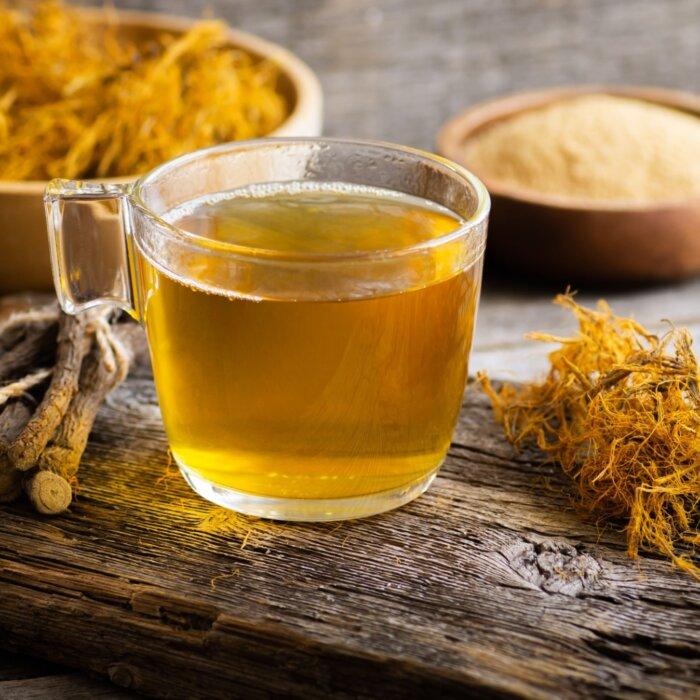
Another approach to removing age spots is to reduce melanin synthesis. Chen introduced three commonly used, easy-to-prepare herbs that can inhibit the conversion of tyrosinase to melanin.
Dark Spot Fading Tea
Ingredients
Preparation
Add ingredients to water in a pot. Bring to a boil, then reduce heat and simmer for five minutes. Remove from heat and steep for about 20 minutes before drinking. Alternatively, crush the ingredients and place them in a tea bag before steeping with boiling water.
Benefits
-
Ginseng Rootlets: Qi-tonifying effects, and can fight aging and promote metabolism
-
Licorice Root: Anti-inflammatory and skin-soothing effects. Wild licorice root is considered the best. Studies have shown that licorice extract has antioxidant properties and can reduce melanin synthesis by inhibiting tyrosinase activity.
-
Mulberry Leaves: Excellent whitening and melanin-blocking effects
Acupuncture and Fire Needle Therapy
Chen also treats pigmentation externally.
For flat areas of pigmentation, she uses very fine needles around the affected area—a technique she describes as scattered needling or micro-needling. In TCM, the goal is to promote local circulation and support repair.
Chen said that when internal treatment and acupuncture are combined, some patients notice that pigmentation begins fading within one to two weeks, sometimes accompanied by improvement in fine lines.
For raised spots, Chen sometimes uses fire needling, a traditional technique in which a specialized needle is heated and briefly applied to the lesion. The treatment creates a small controlled injury, after which the area forms a scab that is allowed to fall away naturally.
There is an important precaution, however: a raised or changing pigmented lesion should not automatically be assumed to be an age spot.
Any spot that is new, changing in size or color, irregular, bleeding, itching, or otherwise unusual should first be evaluated by a dermatologist to rule out skin cancer or another condition before undergoing a destructive treatment.
Looking Beyond the Surface
TCM and modern gut–skin research use very different languages and should not be considered equivalent. TCM describes patterns such as dampness, heat, qi, and blood, while modern researchers study microbes, metabolites, immune pathways, and oxidative stress.
Yet both approaches raise a similar question: Could healthy skin depend partly on what is happening beyond the skin itself?
That does not mean that “toxins” stored in the intestine simply emerge as facial spots, nor is there good evidence that improving bowel movements alone will erase age-related pigmentation.
But Chen’s approach highlights a broader principle increasingly relevant to modern research: caring for the skin may involve more than treating its surface.
For healthy aging, maintaining regular bowel habits, eating a fiber-rich diet, staying adequately hydrated, protecting the skin from excessive ultraviolet exposure, and seeking appropriate care for suspicious skin changes may all have a role.