





Commentary
The New South Wales (NSW) government is planning for 9,400 new homes in Sydney’s eastern suburbs over the next two decades, with towers reaching more than 30 storeys around railway stations.
But rezoning land for thousands of apartments is one thing, finding developers willing to build them and purchasers able to buy them is another.
Buildings could reach 34 storeys around Edgecliff and 32 storeys around Woollahra, with about 40 percent of proposed homes within 200 metres of a railway station.
The Minns government said the plan would address the housing shortage by putting more homes close to the CBD, jobs and public transport. An affordable housing contribution—state support to fund portions of the project—would start at 3 percent and rise to as much as 15 percent for certain sites.
Related Stories


A screenshot of a flyover of the proposed Edgecliff-Woollahra precinct, set to be rezoned under a state Labor government plan. Screenshot/The Epoch Times
What Costs do Developers Have to Deal With?
The question is whether enough projects will be commercially viable to turn that planning capacity into homes.
Developers face elevated construction costs, financing requirements and pressure to achieve sufficient presales before lenders will release construction finance.
The pressures were highlighted in August when major NSW developer Bathla Group entered voluntary administration, with Managing Director Bhart Bhushan citing softer sales and higher construction costs among the factors affecting the business.
Bathla’s circumstances do not mean developments in Edgecliff and Woollahra will suffer the same fate, but they illustrate the pressures facing residential developers.
The government has acknowledged financing difficulties through its $1 billion (US$700 million) Pre-Sale Finance Guarantee, under which the state can commit to buying apartments off the plan to help qualifying developments satisfy lenders’ pre-sale requirements, subject to eligibility and government approval.
The program does not, however, transfer construction and residential market risk from developers to the government.
That leaves developers needing buyers prepared to place deposits on apartments they may not occupy for several years, potentially while continuing to pay rent or other housing costs.

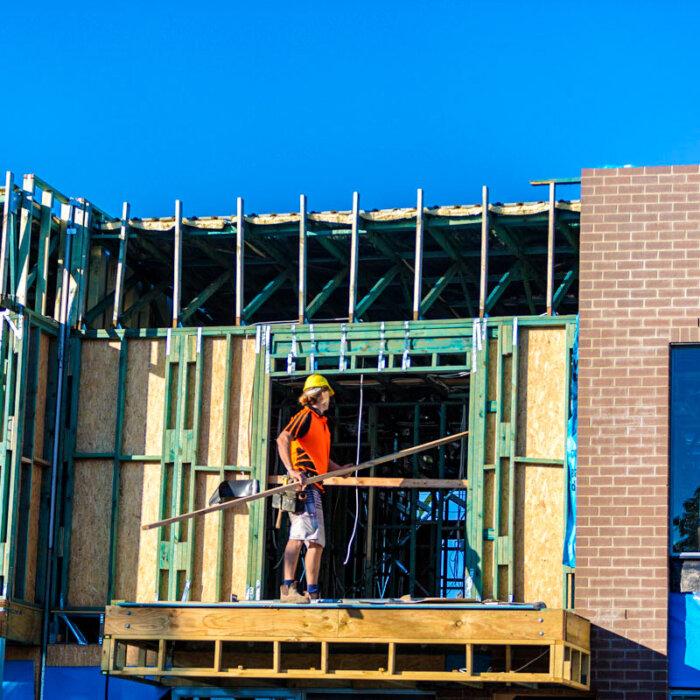
Construction workers are seen on a building site above pedestrians in the central business district (CBD) of Sydney, on May 12, 2026. David Gray/AFP via Getty Images
Existing Apartments Over $1 Million
According to realestate.com.au, two-bedroom units currently have median prices of about $1.73 million in Edgecliff and $1.54 million in Woollahra, while three-bedroom units have median prices of $2.91 million and $2.6 million, respectively.
Those figures largely reflect the existing apartment market. New apartments must also absorb current land, construction, financing, risk and regulatory costs and meet minimum quality standards.
Apartments on the upper levels of 30-storey towers with Sydney Harbour, CBD or district views could command substantial premiums. What will the remaining apartments actually cost when they reach the market?
Towers Would Transform the Area
The proposed towers would also dramatically increase the scale of development in the area.
While Edgecliff has several high-rises, including the 30-storey Ranelagh tower, much of New South Head Road is three to four storeys.
Ranelagh has previously been described in planning documents as an “anomaly” that should not be replicated.
However, the new plan would allow towers of 32 to 34 storeys, potentially setting expectations for future development.
Build Up or Build Out?
The draft rezoning also raises a broader question about Sydney’s housing strategy: should governments substantially increase density in established suburbs, or accelerate new master-planned communities where housing and infrastructure can be developed together?
Adding 9,400 homes requires more than additional rail capacity. Thousands of new households will increase demand for schools and childcare, medical services, supermarkets and other retail, parks, roads, utilities and community facilities.
Woollahra Council has questioned whether sufficient infrastructure has been planned to support the proposed population increase.
Victoria is pursuing a similar density strategy in established Melbourne suburbs, including affluent Brighton.
Around Middle Brighton, new controls generally allow buildings of six to eight storeys, with heights of up to 12 storeys on some larger sites, well below the 32 and 34 storeys proposed for Woollahra and Edgecliff.
The debate is therefore not simply about building up or building out, but where the infrastructure needed to support thousands of additional households can most effectively be delivered.
The test for the Edgecliff-Woollahra proposal will not simply be whether planning rules permit 9,400 homes, but whether they can actually be built at prices that support the government’s housing affordability objectives.
Views expressed in this article are opinions of the author and do not necessarily reflect the views of The Epoch Times.