





Hours spent at a computer or looking down at a phone can leave more than your neck feeling stiff. When sitting dominates the day, the muscles that help stabilize your spine—particularly the core, glutes, and back—may not be challenged enough to stay strong and supportive.
The solution is not simply to “sit up straight.” Building strength in these supporting muscles can help improve stability, make it easier to maintain good posture, and prepare the body for the demands of everyday movement.
The following 10-minute routine targets these key muscle groups and can be done at home with no special equipment.
Why Sitting All Day Can Leave Your Back Vulnerable
The human body is designed to move, but modern life often requires the opposite. Working at a computer, commuting, watching television, and using a phone can add up to many hours of sitting each day.
During prolonged sitting, the hips remain flexed while the glutes and other muscles involved in standing and movement are relatively inactive. If this becomes a daily pattern, some muscles may become tight while others are not challenged enough.
Related Stories
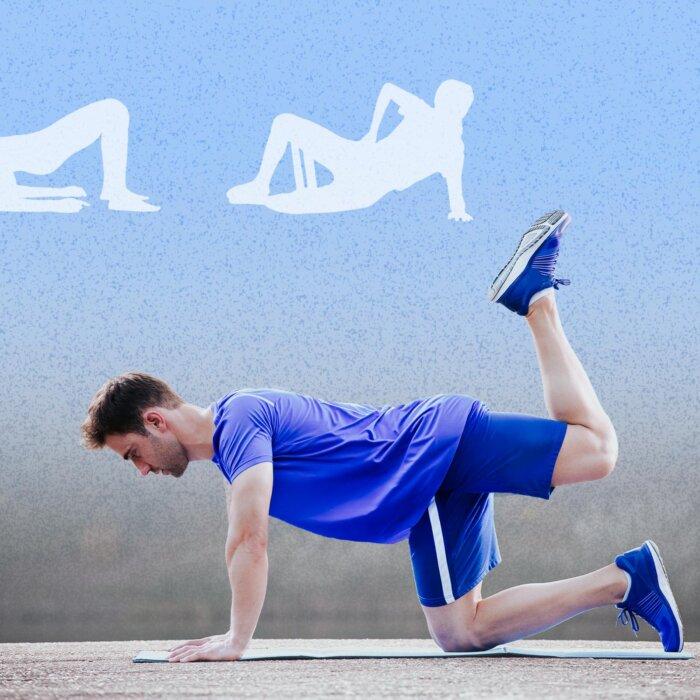

The result can be a less efficient support system around the pelvis and spine. The abdominal muscles, back muscles, and glutes work together to stabilize the trunk, control the pelvis, and transfer force between the upper and lower body.
This is one reason exercise—not simply trying to maintain one “perfect” posture—is important for people who spend much of their day sitting.
Your Spine Needs More Than Strong Back Muscles
It is easy to assume that preventing back problems means strengthening the back. In reality, spinal stability depends on a team of muscles.
The abdominal muscles help stabilize the trunk. The glutes help control the pelvis and hips. Muscles along the back help support and move the spine. When these muscle groups coordinate effectively, they provide a more stable foundation for everyday activities such as standing, walking, bending, and lifting.
Dr. Cheng-Li Lin, associate professor and director of the spine surgery division in the Department of Orthopedics at National Cheng Kung University Hospital in Taiwan, has similarly emphasized strengthening the back and abdominal muscles for spinal support, including for people with herniated discs.
Exercise is also part of evidence-based care for chronic primary low back pain. The World Health Organization recommends that structured exercise programs may be offered as part of care.
For people without significant spinal problems, regularly working the core, glutes, and back can be a practical way to build the muscular support needed for daily movement.
Here is a routine that puts that principle into practice.
10-Minute Back-Strengthening Exercises
Perform the following movements slowly and with control. Rather than focusing on how high you can lift your legs or torso, concentrate on keeping the core engaged and maintaining good form.
1. Leg Raises
Step 1: Lie flat on a sturdy surface. Place your hands beside your body or under your hips for support. Keep your legs together and fully extended.
Step 2: As you inhale, engage your lower abdominals and slowly raise both legs until they are at about a 90-degree angle.
Step 3: As you exhale, slowly lower your legs until they are close to the floor without touching it. Keep your core engaged and your lower back pressed against the floor throughout the movement.
2. Hip Thrust
Step 1: Lie flat on a sturdy surface with your legs extended and your hands resting beside your body.
Step 2: As you exhale, tighten your abs and glutes, slightly curl your pelvis upward, and lift your hips off the floor. As you inhale, slowly return to the starting position.
3. Glute Bridge Kick–Right
Step 1: Lie flat on a sturdy surface with your hands beside your body. Extend your right leg straight and bend your left knee, placing your left foot along the center line of your body.
Step 2: As you exhale, engage your glutes and lift your hips until your shoulders, hips, and left knee form a straight line. At the same time, kick your right leg upward to a 90-degree angle. As you inhale, lower your hips and right leg back to the starting position. Repeat several times.
4. Glute Bridge Kick–Left
Step 1: Lie flat on a sturdy surface with your hands beside your body. Extend your left leg straight and bend your right knee, placing your right foot along the center line of your body.
Step 2: As you exhale, engage your glutes and lift your hips until your shoulders, hips, and right knee form a straight line. At the same time, kick your left leg upward to a 90-degree angle. As you inhale, lower your hips and left leg back to the starting position. Repeat several times.
5. Single-Leg Glute Bridge–Right
Step 1: Lie flat on a sturdy surface with your hands beside your body. Bend your right knee and hold it lifted in the air. Bend your left knee and place your left foot along the center line of your body.
Step 2: As you exhale, engage your glutes and lift your hips until your shoulders, hips, and left knee form a straight line, while lifting your right knee upward. As you inhale, lower your hips and right leg, then rotate your right knee outward and move your right leg horizontally across your left leg. Repeat several times.
6. Single-Leg Glute Bridge–Left
Step 1: Lie flat on a yoga mat with your hands beside your body. Bend your left knee and hold it lifted in the air. Bend your right knee and place your right foot along the center line of your body.
Step 2: As you exhale, engage your glutes and lift your hips until your shoulders, hips, and right knee form a straight line, while lifting your left knee upward. As you inhale, lower your hips and left leg, then rotate your left knee outward and move your left leg horizontally across your right leg. Repeat several times.
7. Superman Reach
Step 1: Lie face down on a sturdy surface with your legs extended. Place your arms beside your body in a “W” shape, then lift your chest, arms, and legs off the floor.
Step 2: As you exhale, extend both arms forward. As you inhale, bring your arms back to the starting position. Repeat several times. Keep your chest, arms, and legs lifted off the ground throughout the movement.
8. Superman ‘W’ Raise
Step 1: Lie face down on a sturdy surface with your legs extended and your arms positioned beside your body in a “W” shape.
Step 2: As you exhale, engage your core and lift your chest, arms, and legs off the floor. As you inhale, lower your chest, arms, and legs back to the floor. Repeat several times.
9. Superman Leg Raise
Step 1: Lie face down on a sturdy surface with your legs extended. Place your hands together on the floor and rest your head on your hands.
Step 2: Engage your core, glutes, and back muscles, then lift both legs off the floor. Hold this position for 40 seconds.
10. Superman Hold
Step 1: Lie face down on a sturdy surface with your legs extended and your arms beside your body in a “W” shape.
Step 2: Engage your core, glutes, and back muscles while lifting your chest, arms, and legs off the floor. Hold this position for 40 seconds.
Don’t Just Correct Your Posture—Build Support
If you spend much of the day sitting, good posture alone may not be enough. Regular movement, combined with strengthening the core, glutes, and back, can help provide the stability your spine needs for everyday activities.
Even 10 minutes of focused exercise can be a practical place to start. The key is consistency: move often, build strength, and avoid staying in one position for too long.
Safety note: People with a herniated disc, spondylolisthesis, osteoporosis, a recent spinal injury or surgery, or persistent back pain should seek professional guidance before beginning a new exercise routine. Stop exercising and seek medical advice if a movement causes significant or worsening pain, numbness, tingling, or weakness.